.jpg)

Efficacy of Carbamide Peroxide and Sodium Perborate as Bleaching Agent in Non-Vital Discolored Teeth
Sikander Memon1*  and Feroze Kalhoro1
1Institute of Dentistry, Liaquat University of Medical and Health Sciences, Jamshoro, Sindh, Pakistan .
http://dx.doi.org/10.12944/EDJ.02.01.06
To estimate the effectiveness of sodium perborate with carbamide-peroxide (urea peroxide) to remove the staining of non-vital discolored teeth. Comparative cross sectional study. Dental department of operative dentistry, LUMHS, Jamshoro Sindh, Pakistan, from December 15-12-2014 to June 15-6-2015. A total of 160 single rooted teeth with intact clinical crowns have been collected. Using human blood, the teeth were discolored. With the vita shade guide, shades of discolored teeth were taken. Each tooth was handled with the root canal. 2 mm of root-canal-filling material cleaned under the junction of cement-enamel. In addition, it was then coated with glass ionomer cement 1 mm thickness. Teeth were divided randomly into two groups based on bleaching content used in the pulp chamber; group-A (C.P): 16% Carbamide-peroxide. Group-B (S.P): tetra-hydrate sodium-perborate mixed with distilled water. After 21days, the results were checked for efficacy. The analysis included a total of 160 teeth extracted (80 teeth extracted in each group). In group A, 78 (51.7%) found effectiveness compared to 73 (48.3%) in group B. The experimental groups showed statistically similar bleaching results at the end of twenty one days and p value found to be not significantly different (p=0.078). With a significant result, intracoronal bleaching of non-vital colored teeth is less invasive, comparatively safe and effective to remove the staining of non-vital discolored teeth.
Carbamide-Peroxide; Discoloration; Non-Vital Teeth Whitening; Sodium-Perborate
Copy the following to cite this article:
Memon S. N, Kalhoro F, Memon S. M. Efficacy of Carbamide Peroxide and Sodium Perborate as Bleaching Agent in Non-Vital Discolored Teeth. Enviro Dental Journal 2021; 2(1). DOI:http://dx.doi.org/10.12944/EDJ.02.01.06
Copy the following to cite this URL:
Memon S. N, Kalhoro F, Memon S. M. Efficacy of Carbamide Peroxide and Sodium Perborate as Bleaching Agent in Non-Vital Discolored Teeth. Enviro Dental Journal 2021; 2(1). Available From : https://bit.ly/3bUckOU
Download article (pdf) Citation Manager

Introduction
Discolored anterior teeth are often supposed to distract esthetically, because of increasing need for beautiful, white teeth and concern of esthetic treatment methods; Bleaching of non-vital teeth has become slowly important in recent years. The most commonly used materials for teeth whitening are sodium perborate (PBS), hydrogen-peroxide (H2O2) and intracoronal bleaching carbamide-peroxide..1–3
Hydrogen peroxide has been shown to be effective blanchers to remove stains in both vital as well as non-vital endodontically treated teeth. Hydrogen peroxide as bleaching agent appears to be of great usefulness to remove stains in vital as well as in non-vital teeth. Carbamide-peroxide was introduced for bleaching of vital teeth. Now in recent times it has also been endorsed as an intra-coronal bleaching.4 Sodium-perborate, also commonly used in bleaching of nonvital teeth, subsequent to mixing with water it decomposed into hydrogen peroxide that’s released oxygen.5,6 Currently, Sodium-perborate and Carbamide-peroxide are used owing to insignificant tissues harm by these materials. Sodium-perborate is a safe bleaching material, while thirty percent hydrogen peroxide has been reported as caustic, therefore, instead of hydrogen peroxide, sodium-perborate along with distilled water is indicated. Carbamide-peroxide has been recently acknowledged for use in the removal of non-vital teeth discoloration and use as an intracoronal bleaching.7
This material also has a slower peroxide liberation and it is considered more potent than hydrogen peroxide. This slower release of hydrogen lightens the staining. The use of perborate sodium and carbamide peroxide as an alternative to hydrogen peroxide is now recommended.8 At this time a small number of studies in the literature so as to assess the usefulness of carbamide peroxide thus it is not cleared that which is more effective agent thus this study is aimed to evaluate that among sodium perborate and carbamide peroxide which bleaching agent is more effective intracoronal bleaching agents for removing the discoloration on non-vital endodontically treated teeth.
Materials and Methods
In this comparative cross sectional study, 160 Single rooted extracted teeth with intact clinical crown were selected from the Oral Surgery Outpatients Department. Inclusion criteria included, Single rooted teeth, Intact clinical crown and exclusion criteria included Grossly carious teeth, root fracture. Teeth was cleaned and stored in saline solution or (NaCl 0.9%).Teeth was discolored using fresh human blood obtained from different blood banks for 18 days. Blood was changed each day and the staining process was continued for 18 successive days. Shade of discolored teeth was taken with a Vita shade guide. The opening of the coronal access was made under high-speed water-coolant by diamond-bur. The root canal was made for each tooth using step-back techniques and obturation techniques using sealer and gutta percha cold-lateral condensation. Under the cement-enamel junction, 2 mm of the root canal filling was added and 1 mm thick glass-ionomer cement base sealed. Upon washing with ordinary saline solution, the pulp chambers of all teeth were 17% EDTA for 3 minutes. The teeth are randomly divided into two classes based on the type of bleaching material used in the pulp chamber. Group-1 16% Carbamide-peroxide-gel and Class 2 tetra-hydrate Sodium-perborate in a liquid ratio of 2 g to 1 ml combined with distilled water. After placement of bleaching agents, the access-cavities were conserved with temporary cement. Then temporary-cement was extracted along with the bleaching-material rinsed with water and then a new bleaching-session was done. This process was repeated-twice in intervals of seven-days. For clinical analysis, other experienced clinician or supervisor viewed all teeth (instantly after artificial-staining and after 21-days of bleaching). Final outcome were assessed after 21days in terms of efficacy. All the data were entered in pre-design proforma.
IBM SPSS version 23.0 was used to perform the statistical analysis. Frequency and percentages were calculated for bleaching efficacy. Efficacy was stratified with respect to type of tooth to see the association between both groups. Chi-square test with 95% confidence interval was applied to compare the efficacy between two groups. P-value ≤ 0.05 was measured as statistically significant level.
Results
A total of 160 single rooted extracted teeth (80 teeth in each group) were included during the study period of six months from december 15- 12- 2014 to june 15- 6-2015. Group A-carbamide peroxide and Group-B sodium perborate. The central incisors 31% were the most common type of teeth included in this study followed by First premolar 23%, second premolars 21%, lateral incisors 19% and canines 6%. (Table No.1)
Carbamide peroxide and sodium perborate 50% and 50% were the types of bleaching agents respectively. (Table No.2)
Efficacy was seen positive in 94% cases. (Figure No.1)
Out of 160 (100%) extracted teeth, in 51% of cases carbamide peroxide was effective, where as in 48% of cases sodium perborate was effectiveComparing that between two groups there was no statistically significant difference. (Table No.3)
Table 1: Frequency of Type of Tooth
|
Type oF Tooth |
Frequency |
Percentage (%) |
|
Central Incisor |
50 |
31.2 |
|
Lateral Incisor |
30 |
18.8 |
|
Canine |
10 |
6.2 |
|
First Premolar |
37 |
23.1 |
|
Second Premolar |
33 |
20.6 |
|
Total |
160 |
100.0 |
Table 2: Frequency of Type of Bleaching Agents
|
Type of Bleaching Agents |
Frequency |
Percent |
|
Carbamide Peroxide |
80 |
50.0 |
|
Sodium Perborate |
80 |
50.0 |
|
Total |
160 |
100.0 |
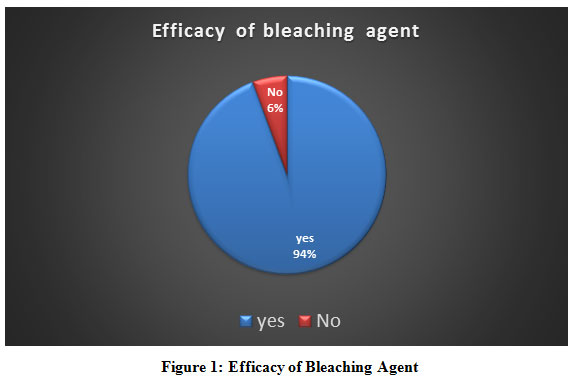 |
Figure 1: Efficacy of Bleaching Agent. Click here to view Figure |
Table 3: Efficacy of Bleaching Agent
|
|
|
Efficacy of Bleaching Agents |
Total |
P-value |
|
|
Group of Bleaching Agents |
|
Yes |
No |
||
|
|
Carbamide Peroxide |
78 |
2 |
80 |
|
|
51.70% |
22.20% |
50.00% |
|
||
|
Sodium Perborate |
73 |
7 |
80 |
|
|
|
48.30% |
77.80% |
50.00% |
0.078 |
||
|
Total |
151 |
9 |
160 |
|
|
|
100.00% |
100.00% |
100.00% |
|
||
Discussion
The outcome of the current study highlights that the technique of internal bleaching is expected to be simple, fast and low-cost. It retained the tooth structure and preserved the natural shape, occlusion and tooth functionality. In their analysis, Valera et al.9 measured the efficiency of sixteen percent CP gel, sodium-perborate (SP) tetra-hydrate and the mixture of both bleaching agents in walking bleaching techniques. Sixty human premolar teeth with unbroken crowns were included in this study. The decoloration of the teeth was collected through the use of fresh blood rabbit. Shade assessment was performed via the Vita shade guide. Both groups received statistically related bleaching results (p>0.05). At the end of twenty-one days, eighty percent of discolored teeth resumed their original color in group 1 Carbamide peroxide (CP), and at the end of twenty-one days, 93.33% of discolored teeth resumed their original color in group 2 tetrahydrate sodium perborate (SP).
Certain media used for extracted teeth discoloration include various colors, coffee, etc. Teeth collected in this study were cleaned and preserved in saline solution or (NaCl 0.9%).Teeth are discolored for 18 days using fresh human blood obtained from different blood banks.
Our study results are consistent with those reported by Valera et al, and both carbamide peroxide and sodium perborate bleaching agents at the end of twenty-one days produced statistically similar bleaching results, and p was found not to be significantly different (p>0.05). Comparing to Lim, et al.9, it is apparent that visual-color determination is independent, as compared to the accuracy of the spectrophotometer evaluation.10 However, Vac hon, et al.7 advised that, while spectrophotometer readings can show a difference, these differences may be scientifically balanced with the human eye, a deviation that is statistically significant. Consequently, using the Vita-Lumin shade guide, only a few studies used both visual and spectrophotometer to determine the efficacy of bleaching agents in color change, and the results of both studies are clear. In this analysis, color variations are analyzed under standardized lighting conditions in each sample using the Vita shade guide. Taking into account the current data, there is no statistical difference between the two methods in the study. Therefore, both techniques (photographic examination and Vita shade guide) may be suggested to determine the effectiveness of bleaching agents applied to discolored teeth through blood decomposition. Weiger, et al.11 has shown that sodium perborate monohydrate produces high amounts of active oxygen, but that fusion with hydrogen peroxide or water becomes inefficient after 1 hour. The Trihydrate (NaBO3·nH2O) sodium perborate displays 11.8% of active oxygen and setting within one day. Sodium perborate tetrahydrate, on the other hand, provides small amounts of active oxygen (10.4%), the environment takes place after seven days. NaBO3·nH2O is suggested as it remains active until the bleaching agent is changed (seven days). In addition, the amount of hydrogen peroxide (H2O2) infiltration depends on the perborate form of sodium,12 and infiltration is significantly high in combination with sodium perborate mono or tetrahydrate and hydrogen peroxide and less in combination with H2O2 trihydrate or tetrahydrate and water mixture. While the sodium perborate three types are applicable, the type of tetra hydrate is usually used in walking bleaching techniques.13 Weiger et al. also used 3 different forms of perborate sodium and indicated that although the monohydrate had the maximum active oxygen content, there was no significant difference between them.
Lim, et al. (2004) verified that thirty five percent carbamide peroxide and thirty five percent hydrogen peroxide were effective for removing the discoloration of non vital endodontically treated teeth, and were considerably healthier than Sodium perborate after 7 days mixed with water.
Our study results are consistent with those recorded by Lim, et al. Carbamide peroxide and sodium perborate have both been effective in bleaching stained teeth blood products, particularly after twenty-one days.14
In their study of internal teeth bleaching, P Abbott et al.12 concluded that the primary color had a significant effect on the results of bleaching (p= 0.000). Originally gray teeth were the most expected to bleach in all gray teeth with a'' good''' color alteration. Light yellow and black discolorations had slightly fewer positive results, which is 94.9% and 86.1%, respectively'' poor'') while only 67.5% of dark yellow teeth had a'' better'' score. It was noteworthy that all the teeth in this study had either'' natural'' or'' acceptable'' color changes due to bleaching and no teeth had any improvement of color. The results obtained with the internal bleaching technique used in the current study are supporting and encouraging previous reports,15,16 that established internal bleaching as an anticipated technique. In this experiment, teeth had enough color alteration following intracoronal bleaching of discolored endodontically treated teeth and statistically insignificant difference between the two bleaching agents.
Conclusion
The results of this study indicate intracoronal bleaching of non-vital colored teeth is less invasive, comparatively safe and effective to remove the staining of non-vital discolored teeth. The intracoronal bleaching is extensively used in discolored, non-vital teeth because it is competent, comparatively uncomplicated, and when compared with prosthetic management, it retains the tooth structure. The results of this study indicate that carbamide peroxide and sodium perborate are active whitening agents for bleaching endodontically treated discolored teeth.
Acknowledgments
The research authors of this study would like to show their gratitude to Dean Institute of Dentistry Prof. Dr. Feroze Kalhoro for funding, supervision and support in the completion of the project.
Conflict of Interest
The authors have declared that completing interest exists.
References
- Marchesan MA, James CM, Lloyd A, Morrow BR, García-Godoy F. Effect of access design on intracoronal bleaching of endodontically treated teeth: An ex vivo study. J Esthet Restor Dent. August 2017. doi:10.1111/jerd.12335.
CrossRef - Tran L, Orth R, Parashos P, et al. Depletion Rate of Hydrogen Peroxide from Sodium Perborate Bleaching Agent. J Endod. 2017;43(3):472-476. doi:10.1016/j.joen.2016.10.043.
CrossRef - Shaheen MAEM, Elkateb MA, Bakry NS, et al. Efficacy of 10 percent carbamide peroxide as an intracoronal bleaching agent in nonvital discolored primary teeth: An in vitro study. J Dent Child. 2017;84(1):22-29.
- Sood A, Dhawan D, Mittal R, Singla M. A comparative evaluation of efficacy of commercially available bleaching agents in non-vital teeth: An in vitro study. Saudi Endod J. 2015;5(1):33. doi:10.4103/1658-5984.149084.
CrossRef - Rokaya ME, Beshr K, Hashem Mahram A, Samir Pedir S, Baroudi K. Evaluation of Extraradicular Diffusion of Hydrogen Peroxide during Intracoronal Bleaching Using Different Bleaching Agents. Int J Dent. 2015;2015:1-7. doi:10.1155/2015/493795.
CrossRef - Lou EK, Cathro P, Marino V, Damiani F, Heithersay GS. Evaluation of Hydroxyl Radical Diffusion and Acidified Thiourea as a Scavenger during Intracoronal Bleaching. J Endod. 2016;42(7):1126-1130. doi:10.1016/j.joen.2016.04.010.
CrossRef - Harshitha C. Effects of tooth whitening agents in non vital teeth. J Pharm Sci Res. 2014;6(3):124-126.
- Burrell KH. ADA supports vital tooth bleaching--but look for the seal. J Am Dent Assoc. 1997;128 Suppl:3S-5S. doi:10.14219/jada.archive.1997.0422.
CrossRef - Vachon C, Vanek P, Friedman S. Internal bleaching with 10% carbamide peroxide in vitro. Pract periodontics aesthetic Dent. 1998;10(9):1145-1148.
- Badole GP. Aesthetic Rehabilitation of Discoloured Nonvital Anterior tooth with Carbamide Peroxide Bleaching: Case Series. J Clin DIAGNOSTIC Res. 2013. doi:10.7860/JCDR/2013/6303.3857.
CrossRef - Weiger R, Kuhn A, Laast C. Radicular penetration of hydrogen peroxide during intra-coronal bleaching with various forms of sodium perborate. Int Endod J. 1994;27(6):313-317. doi:10.1111/j.1365-2591.1994.tb00275.x.
CrossRef - Abbott P, Heah SYS. Internal bleaching of teeth: An analysis of 255 teeth. Aust Dent J. 2009;54(4):326-333. doi:10.1111/j.1834-7819.2009.01158.x.
CrossRef - Rotstein I, Torek Y, Misgav R. Effect of cementum defects on radicular penetration of 30% H2O2 during intracoronal bleaching. J Endod. 1991;17(5):230-233. doi:10.1016/S0099-2399(06)81927-8.
CrossRef - Valera MC, Camargo CHR, Carvalho CAT, de Oliveira LD, Camargo SEA, Rodrigues CM. Effectiveness of carbamide peroxide and sodium perborate in non-vital discolored teeth. J Appl Oral Sci. 2009;17(3):254-261. doi:10.1590/S1678-77572009000300024.
CrossRef - Chandra S, Chawla TN. Clinical evaluation of various chemicals and techniques of bleaching of discolored root filled teeth. J Indian Dent Assoc. 1972;44(8):165-171.
- Migliau G. Endo-restorative treatment of a severly discolored upper incisor: resolution of the aesthetic problem through Componeer veneering System. Ann Stomatol (Roma). 2016. doi:10.11138/ads/2015.6.3.113.
CrossRef