.jpg)

Clinical Effectiveness and User Preference of Bamboo and conventional Toothbrushes among Children Aged 8–12 Years: A Randomized Controlled Crossover Study
Avula Jogendra Sai Sankar1*  , Kundeti Siva Sankar2 , Gattu Kavya Sri2 and Kakarla Pranitha1
1Department of Pedodontics and Preventive Dentistry, Sibar Institute of Dental Sciences, Guntur, India .
2Department of Pediatric and Preventive Dentistry, Sibar Institute of Dental Sciences, Guntur, India .
Dental plaque is a major etiological factor in the development of dental caries and periodontal diseases, making effective plaque control essential in children. With increasing environmental concerns, biodegradable bamboo toothbrushes have emerged as a sustainable alternative to conventional plastic toothbrushes; however, evidence comparing their clinical efficacy in pediatric populations remains limited. This crossover in vivo study evaluated and compared the plaque removal efficacy of plastic and bamboo manual toothbrushes in 44 healthy school-going children aged 8–12 years. Participants used a plastic toothbrush for two weeks, followed by a one-week washout period and subsequent use of a bamboo toothbrush for another two weeks. Plaque scores were assessed before and after each intervention using the Turesky-Gilmore-Glickman modification of the Quigley-Hein Plaque Index, and user preference was evaluated through a subjective questionnaire. Both toothbrushes demonstrated significant reductions in plaque scores, with plastic toothbrush scores decreasing from 1.76 ± 0.37 to 0.77 ± 0.28 and bamboo toothbrush scores from 1.93 ± 0.35 to 0.73 ± 0.28 (p < 0.001), with no significant difference between the two groups after intervention (p = 0.680). Subjective evaluation revealed that 85% of participants reported a better brushing experience with bamboo toothbrushes, while 65% preferred them over plastic toothbrushes. Within the limitations of the study, bamboo toothbrushes were found to be as effective as conventional plastic toothbrushes in plaque removal while demonstrating high user acceptability, supporting their use as an environmentally sustainable alternative for maintaining oral hygiene in children.
Copy the following to cite this article:
Sankar A. J. S, Sankar K. S, Sri G. K, Pranitha K. Clinical Effectiveness and User Preference of Bamboo and conventional Toothbrushes among Children Aged 8–12 Years: A Randomized Controlled Crossover Study. Enviro Dental Journal 2026;8(2).
Copy the following to cite this URL:
Sankar A. J. S, Sankar K. S, Sri G. K, Pranitha K. Clinical Effectiveness and User Preference of Bamboo and conventional Toothbrushes among Children Aged 8–12 Years: A Randomized Controlled Crossover Study. Enviro Dental Journal 2026;8(2). Available here: https://bit.ly/4zebhkg
Citation Manager

Introduction
Oral health is an integral part of overall health, influencing an individual’s quality of life, nutritional status, speech, self-esteem, and overall well-being. Among various oral health issues, dental plaque-induced diseases such as dental caries, gingivitis, and periodontitis are the most prevalent, especially in children.1 Dental plaque is a complex microbial biofilm that forms on the tooth surface and serves as the primary etiological factor in the initiation and progression of these diseases. Effective removal of plaque is therefore essential in the maintenance of oral hygiene and prevention of dental pathologies.2
The most common and effective method for mechanical removal of plaque is toothbrushing. Manual toothbrushes are the primary oral hygiene tool used globally across all age groups. Their effectiveness in plaque removal largely depends on multiple factors such as the design of the brush head and bristles, the brushing technique employed, duration and frequency of brushing, and the user’s manual dexterity.3,4 In pediatric populations, these factors become even more critical as children often lack the coordination and motivation to brush effectively without supervision.
Traditional manual toothbrushes are predominantly made of plastic. While plastic brushes offer design flexibility, durability, and cost-effectiveness, their widespread use and non-biodegradable nature contribute significantly to environmental pollution. It is estimated that billions of plastic toothbrushes are discarded each year, most of which end up in landfills or oceans, persisting for centuries without decomposing. This has sparked a growing interest in environmentally sustainable alternatives such as bamboo toothbrushes.5
Bamboo toothbrushes are typically crafted from fast-growing, biodegradable bamboo wood and often paired with soft bristles, some made from nylon or bio-based materials. These brushes have gained popularity as a sustainable, eco-friendly substitute to conventional plastic brushes.6,7,8 However, despite their environmental benefits, questions remain about their effectiveness in plaque removal, especially in pediatric populations where effective cleaning is already a challenge.
There is a lack of sufficient clinical data comparing the plaque removal efficacy of bamboo and plastic toothbrushes in children. Limited existing literature either focuses on adult populations or provides inconclusive results due to variations in study design, bristle types, and brushing habits. This underscores the need for evidence-based research that not only evaluates the clinical efficacy of bamboo toothbrushes but also considers the user acceptability and overall brushing experience in younger age groups.
Hence, the present study was undertaken to compare the plaque removal efficacy of plastic and bamboo toothbrushes in school-going children aged 8 to 12 years. In addition, the study aims to evaluate children’s subjective experiences with both types of toothbrushes to determine if the sustainable alternative compromises comfort or brushing efficiency. The findings of this study will provide valuable insights for parents, caregivers, and dental professionals in making informed decisions about oral hygiene tools for children, while also addressing the broader goal of environmental sustainability.
Aim and Objectives
Aim: To evaluate and compare the plaque removal efficacy of Bamboo and conventional plastic toothbrushes and their preferance in school-going children.
Objectives
1. To assess the effectiveness of plastic toothbrushes in removing dental plaque.
2. To assess the effectiveness of bamboo toothbrushes in removing dental plaque.
3. To compare the plaque removal efficacy between plastic and bamboo toothbrushes.
4. To evaluate user preference and comfort for both types of toothbrushes.
Materials and Methods
This present randomized, two-treatment, two-period crossover clinical trial conducted in the Department of Pediatric and Preventive Dentistry to compare the plaque removal efficacy of plastic and bamboo manual toothbrushes in school-going children.
A total of 250 school-going children aged 8–12 years were initially assessed for eligibility. Of these, 130 children were excluded (90 did not meet the inclusion criteria, 30 declined to participate, and 10 were excluded due to other reasons such as failure to obtain parental consent). Ultimately, 120 eligible participants were enrolled in the study after obtaining informed consent from their parents and assent from them. Children with at least 20 erupted teeth, no systemic illness, no recent oral prophylaxis (within the past 3 months), and no use of orthodontic appliances were considered eligible, while those with more than three extensive carious lesions, recent antibiotic use, or allergies to toothbrush materials were excluded. (Figure -1) The final sample size of 120 participants was determined using G*Power software (v3.1.9.2), based on a two-tailed test with a medium effect size (0.5), power of 95%, and an alpha level of 0.05.
Eligible participants were randomly assigned into two groups using computer-generated random numbers and allocation concealment via sealed opaque envelopes. Group A received the plastic toothbrush during the first two-week phase, followed by a one-week washout period, then used the bamboo toothbrush in the second two-week phase. During this wash out period, participants were instructed to discontinue use of the study toothbrush and return to their regular personal toothbrush and toothpaste. Standard oral hygiene instructions were reinforced, and participants were advised to brush twice daily using the modified Bass technique. The washout period was included to minimize potential carryover effects before commencement of the second intervention phase.
Group B followed the reverse sequence. Prior to the trial, all participants were trained in the modified Bass brushing technique and instructed to brush twice daily for two minutes. Brushing was supervised during school hours and monitored at home using parent-verified compliance logs. Due to the physical appearance of the toothbrushes, participant blinding was not feasible; however, outcome assessors who recorded the plaque scores remained blinded to the allocation sequence to minimize bias.
The primary outcome was plaque removal efficacy, measured using the Turesky-Gilmore-Glickman modification of the Quigley-Hein Plaque Index, with scores recorded at the beginning and end of each intervention phase using disclosed plaque visualization. The secondary outcome was user preference and comfort, assessed using a structured questionnaire completed at the end of both phases.
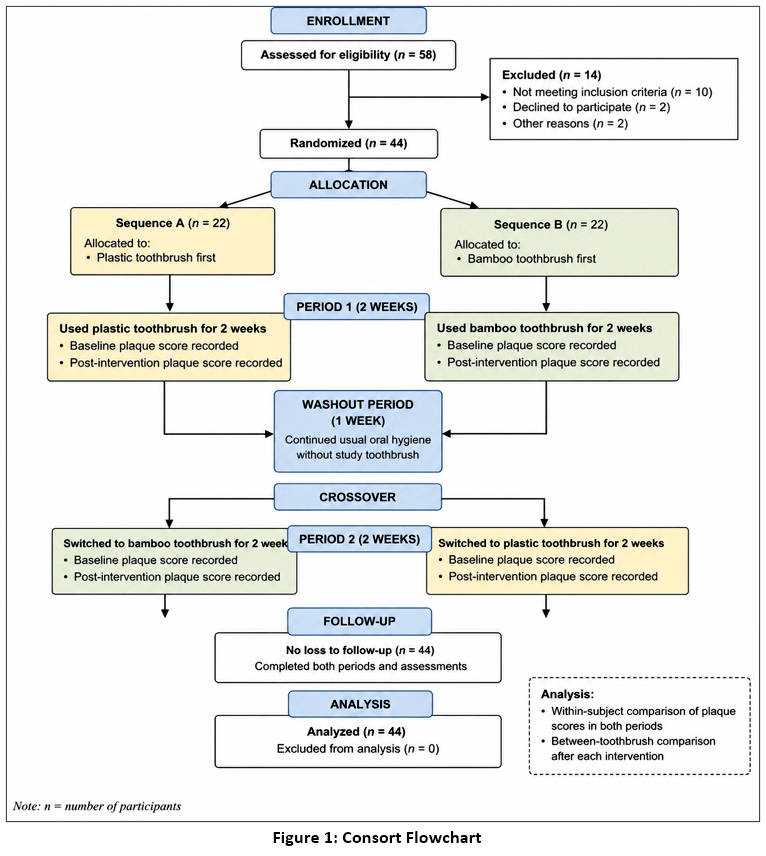 | Figure 1: Consort Flowchart |
All data were analyzed using SPSS version 25.0. Paired t-tests were used to assess intra-group changes in plaque scores before and after each intervention phase, while independent t-tests were used for inter-group comparisons. Additionally, statistical tests were performed to identify potential period and carryover effects inherent to the crossover design. A p-value less than 0.05 was considered statistically significant.
Subjective Evaluation; Participants completed a six-question survey regarding toothbrush preference, comfort, availability, and any experienced trauma.
Results
Both the plastic and bamboo toothbrushes demonstrated statistically significant reductions in plaque scores over the study period. The mean plaque index (PI) score before using plastic toothbrushes was 1.76 ± 0.37, which reduced to 0.77 ± 0.28 after two weeks of brushing (p < 0.001). Similarly, the mean PI score for wooden toothbrushes decreased from 1.93 ± 0.35 to 0.73 ± 0.28 (p < 0.001).
Despite the slightly higher baseline plaque score in the wooden toothbrush phase, the final scores post-intervention were nearly identical between the two groups. The intergroup comparison of post-brushing PI scores showed no statistically significant difference (p = 0.680), indicating that both toothbrush types were equally effective in reducing plaque accumulation.
Subjective responses revealed that 85% of participants reported a better overall brushing experience with bamboo toothbrushes. Additionally, 60% found them more comfortable, and 65% preferred them over plastic brushes. Only 5% of the participants reported any trauma, which was associated with the wooden brush.
Discussion
Dental plaque removal is the cornerstone of effective oral hygiene, particularly among pediatric populations who are prone to developing caries and gingivitis due to improper or irregular brushing.9 This study was designed to compare the plaque removal efficacy and acceptability of plastic and wooden (bamboo) manual toothbrushes in children, providing important insights into their clinical performance and user experience.
The results demonstrated that both toothbrush types significantly reduced plaque scores over a two-week period. The plastic toothbrush group showed a reduction from 1.76 to 0.77, while the bamboo group had a reduction from 1.93 to 0.73, both highly significant (p < 0.001). This indicates that when used correctly, bamboo toothbrushes are just as effective as plastic ones in controlling dental plaque. The lack of statistically significant difference between the two groups in post-treatment plaque scores (p = 0.680) further reinforces this finding.
In addition to objective plaque reduction, the study also explored participants’ subjective experiences with the two types of toothbrushes. The findings revealed a clear preference for bamboo toothbrushes among the children. Specifically, 85% of participants reported a more satisfying overall brushing experience with the bamboo toothbrush, and 60% found it more comfortable to use. Moreover, 65% expressed a preference for bamboo brushes over plastic ones, indicating a favorable user perception of the eco-friendly alternative. These subjective outcomes are particularly important in pediatric populations, where comfort and user satisfaction play a critical role in long-term compliance with oral hygiene routines.
Although a small proportion (5%) of participants reported minor trauma with the bamboo toothbrush, it was not statistically significant and did not deter preference. This suggests that with proper design and bristle quality, bamboo toothbrushes can achieve not only clinical efficacy but also high levels of acceptability and comfort. These findings align with the broader goal of promoting sustainable dental practices without compromising user experience or clinical outcomes.
Our study supports the findings of Kariya et al.10 (2024), who also observed no statistically significant differences between biodegradable and non-biodegradable toothbrushes in children aged 8–10 years. Likewise, Moeintaghavi et al.11 (2017) concluded that different toothbrush designs when used with standardized techniques do not significantly differ in their efficacy. These findings underline the fact that brushing technique and consistency may play a more decisive role than the brush material itself in plaque removal outcomes.
While there are limited studies directly comparing bamboo and plastic toothbrushes in children, some concerns have been raised in literature regarding the stiffness and design of bamboo handles and the use of natural bristles, which may not match the cleaning efficiency of synthetic ones.12, 13 However, in our study, the bamboo toothbrushes used featured soft nylon bristles comparable to those in plastic brushes, likely contributing to their similar performance.
In addition to clinical efficacy, user preference is a crucial factor, especially in pediatric dentistry, where compliance is often influenced by comfort and perceived effectiveness. Our study found that a significant number of children preferred bamboo toothbrushes, citing better comfort and brushing experience.14 These subjective findings are valuable, as they indicate high acceptance of bamboo toothbrushes, which could translate to better compliance and consistent oral hygiene habits over time.
Furthermore, the environmental implications of switching to bamboo toothbrushes cannot be overlooked. With billions of plastic toothbrushes discarded annually, the move towards biodegradable options could have a substantial positive impact on reducing non-biodegradable waste.15,16 Our findings, therefore, have dual implications: supporting sustainable practices and validating their clinical utility.
Recent evidence further supports the clinical and practical relevance of bamboo toothbrushes as an alternative to conventional plastic toothbrushes. Ishii et al.17 (2023) investigated the hygienic condition of bamboo, plastic, and biomass-plastic toothbrushes following use and storage. The authors also reported that pre-wetting the bamboo toothbrush before use improved its hygienic condition. These findings are relevant to the present study because they suggest that the use of bamboo as a toothbrush handle material does not necessarily result in inferior hygienic characteristics, provided that appropriate cleaning and storage practices are followed. Fageeh et al.18 (2024) compared bamboo, Salvadora persica, and conventional nylon toothbrushes in adults and found significant plaque reduction with all three, with no significant difference between groups.
User acceptability is also important, particularly in children. Raidee et al.16 reported favorable perceptions toward eco-friendly bamboo toothbrushes, although limited awareness regarding their use and disposal may affect wider adoption. In the present study, the high proportion of children reporting a better brushing experience and preference for bamboo toothbrushes indicates good acceptability.
From an environmental perspective, Lyne et al.19 (2020) demonstrated that toothbrush selection can influence environmental impact across manufacturing, transportation, and disposal. Bamboo toothbrushes may therefore offer sustainability advantages while maintaining clinical effectiveness.
Limitations
Although the sample size was statistically adequate, the study was conducted at a single centre, which may limit the generalizability of the results to broader pediatric populations. The relatively short study duration also precluded assessment of the long-term effectiveness and durability of the toothbrushes. Furthermore, microbial parameters and gingival health outcomes were not evaluated, which may have provided additional insights into the comparative oral health effects of bamboo and conventional plastic toothbrushes. Future studies incorporating multicentre designs, longer follow-up periods, and comprehensive clinical and microbiological assessments are warranted to further validate these findings.
Table 1: Comparison of mean PI score before and after using plastic brushes.
N | Mean | Std. Deviation | CI -95% | t Value | P-Value | ||
Plastic tooth brushes | pre | 120 | 1.76 | 0.36 | (0.92,1.03) | 36.120 | <0.001* |
post | 120 | 0.78 | 0.27 | ||||
*indicates statistically significance in the p value
Table 2: Comparison of mean PI score before and after using wooden brushes
N | Mean | Std. | CI-95% | t Value | P-Value | ||
Wooden Brushes | pre | 120 | 1.91 | 0.34 | (1.13, 1.22) | 49.155 | <0.001* |
post | 120 | 0.73 | 0.27 | ||||
*indicates statistically significance in the p value
Table 3: Comparison of PI score differences between groups-plastic and wooden brushes
Groups | N | Mean | Std. Deviation | t value | P- Value | |
Pre | Plastic | 120 | 1.75 | 0.36 | -3.344 | 0.001* |
Wooden | 120 | 1.90 | 0.34 | |||
Post | Plastic | 120 | 0.78 | 0.27 | 1.402 | 0.162 |
Wooden | 120 | 0.74 | 0.27 |
Conclusion
The present study demonstrated that both plastic and bamboo toothbrushes are effective in reducing dental plaque in children. Although no statistically significant difference was found between the two, bamboo toothbrushes were preferred by the majority of participants for their comfort and brushing experience. Given their environmental benefits and comparable efficacy, bamboo toothbrushes can be considered a suitable and sustainable alternative to plastic brushes for pediatric oral care.
Acknowledgement
The authors sincerely thank the management of SIBAR Institute of Dental Sciences, Guntur, Andhra Pradesh, for providing the necessary facilities and institutional support to conduct this study. The authors also express their gratitude to the participating children, their parents/guardians, and the school authorities for their cooperation throughout the study.
Funding Sources
The author(s) received no financial support for the research, authorship, and/or publication of this article
Conflict of Interest
The authors do not have any conflict of interest.
Data Availability Statement
This statement does not apply to this article.
Ethics Statement
The study protocol was reviewed and approved by the Institutional Ethics Committee of SIBAR Institute of Dental Sciences, Guntur, Andhra Pradesh (Approval No. ECR/1362/SIBAR/AP/2020). The study was conducted in accordance with the ethical principles of the Declaration of Helsinki.
Informed Consent
Written informed consent was obtained from the parents or legal guardians of all participating children prior to enrolment. Verbal assent was also obtained from all children before participation in the study.
Permission to reproduce material from other sources
Not applicable
Clinical Trial Registration
This study was prospectively registered with the Clinical Trials Registry of India (CTRI) under registration number CTRI/2025/04/083988.
Author’s Contribution
Avula Jogendra Sai Sankar: Conceptualization, Methodology, Writing – Original Draft.
Kundeti Siva Sankar: Data Collection, Analysis, Writing – Review & Editing.
Gattu Kavya Sri: Visualization, Supervision, Project Administration.
Kakarla Pranitha: Supervision, Funding Acquisition
References
- Barranca-Enríquez A, Romo-González T. Your health is in your mouth: A comprehensive view to promote general wellness. Front Oral Health. 2022;3:971223.
CrossRef - G. P. Subramanian and T. S. Sukumar, “A Comprehensive Reviewon Impact of Microbial Biofilms on Dental Plaque Formation and ItsTreatment Strategies,” Biology Bulletin Reviews 14 (2024): 795–803.
CrossRef - Mishal R, Shrestha A, Bhagat T, Agrawal SK. Effectiveness of three manual toothbrushes with different bristle designs in terms of plaque removal and gingival inflammation: A randomized controlled trial. BMC Oral Health. 2025;25(1):1011.
CrossRef - Ccahuana-Vasquez RA, Adam R, Conde E et al. A 5?week randomized clinical evaluation of a novel electric toothbrush head with regular and tapered bristles versus a manual toothbrush for reduction of gingivitis and plaque. Int J Dental Hygiene. 2019;17(2):153–60.
CrossRef - Ranwa S, Manohar B, Patel R, Shekhawat D. A Comparative Study on the Efficacy of Plaque Removal Using Conventional Toothbrushes, Bamboo Toothbrushes, and Neem Toothbrushes among School-going Children. Int J Clin Pediatr Dent. 2025;18(4):420-424.
CrossRef - Wang BJ, Lin CH, Lee WC, et al. Development of a bamboo toothbrush handle machine with a human-machine interactive interface for optimizing process conditions. Sustainability. 2023;15(14):11459.
CrossRef - Knight R. How one practice is using these toothbrushes to reduce plastic waste. Dent Prod Rep. 2020;54
- Duane B, Ashley P, Saget S, et al. Incorporating sustainability into assessment of oral health interventions. Br Dent J. 2020;229(5):310–314.
CrossRef - Toshniwal SH, Reche A, Bajaj P, et al. Status quo in mechanical plaque control then and now: a review. Cureus. 2022;14(8):e28613.
CrossRef - Kariya PB, Desai A, Singh S, Bansal B, Shah Y. Comparing plaque removal efficacy of biodegradable toothbrush and nonbiodegradable toothbrush in children of 8-10 years of age: A randomized clinical study. J Indian Soc Pedod Prev Dent. 2024;42(2):112-118.
CrossRef - Moeintaghavi A, Sargolzaie N, Rostampour M, Sarvari S, Kargozar S, Gharaei S. Comparison of three types of tooth brushes on plaque and gingival indices: a randomized clinical trial. The Open Dentistry Journal. 2017;11:126.
CrossRef - Raidee AS, Helmi FI, Razak MA, Azami NH, Nor NA. Public perception on the use of eco-friendly bamboo toothbrush: Journal of Health and Translational Medicine. 2024 Mar 25:204-14.
- Naik SP, Punathil S, Shetty P, Jayanti I, Jalaluddin M, Avijeeta A. Effectiveness of Different Bristle Designs of Toothbrushes and Periodontal Status among Fixed Orthodontic Patients: A Double-blind Crossover Design. J Contemp Dent Pract. 2018;19(2):150-155.
CrossRef - Mehta S, Vyaasini CS, Jindal L, Sharma V, Jasuja T. Toothbrush, its design and modifications: An Overview. Journal of Current Medical Research and Opinion. 2020;3(08):570.
CrossRef - Lyne A, Ashley P, Saget S, Porto Costa M, Underwood B, Duane B. Combining evidence-based healthcare with environmental sustainability: using the toothbrush as a model. British Dental Journal. 2020;229(5):303-9.
CrossRef - Raidee AS, Helmi FIM, Razak MAA, et al. Public perception on the use of eco-friendly bamboo toothbrush. J Health Transl Med. 2024;25:204–214.
- Ishii Y, Suzuki I, Sakazume-Suzuki H, Kurakawa Y, Uchiyama T, Okada Y, Nagashima T, Taguchi C, Arikawa K. Low-environmental-impact bamboo toothbrushes demonstrate comparable hygienic condition to that of plastic and biomass plastic toothbrushes after use and storage. Int J Oral-Med Sci. 2023;22(1):23-34.
CrossRef - Fageeh HN, Mansoor MA, Fageeh HI, Abdul HN, Mawkili LK, Faris SM, et al. Plaque removal and gingival bleeding using biodegradable toothbrushes: Salvadora persica, bamboo, and nylon: A comparative study. Med Sci Monit. 2024;30
CrossRef - Lyne A, Ashley P, Saget S, Porto Costa M, Underwood B, Duane B. Combining evidence-based healthcare with environmental sustainability: using the toothbrush as a model. Br Dent J. 2020;229(5):303-309.
CrossRef