.jpg)

Reverse Method for Hollowing a Definitive Obturator: A Simplistic Approach
Kumari Deepika1*  , Preeti Mishra2 and Rekha Gupta3
1Department of Prosthodontics and Crown Bridge, AIIMS-CAPFIMS, Maidan Garhi, New Delhi India .
2Department of Dentistry, GTB Hospital, New Delhi India .
3Department of Prosthodontics and Crown Bridge, Maulana Azad Institute of Dental Sciences, New Delhi India .
http://dx.doi.org/10.12944/EDJ.08.0110
Acquired palatal defects may arise from trauma, infection, pathology, radiation therapy, or surgical resection, resulting in oro-nasal communication that adversely affects speech, swallowing, mastication, and patient morale. Obturator prostheses are commonly used to restore these functions; however, in extensive maxillectomy defects, increased prosthesis weight and the absence of adequate retentive undercuts may compromise retention, stability, and patient comfort. Hollowing of the obturator is an effective method for reducing prosthesis weight and improving function. This clinical report describes the rehabilitation of a patient with a total maxillectomy defect secondary to COVID-19-associated mucormycosis using a simplified reverse hollowing technique for fabrication of a definitive obturator. Reverse hollowing was performed from the palatal aspect following conventional processing, and an acrylic shim was incorporated to re-establish palatal contour, thereby improving speech resonance and swallowing efficiency. A heat-cured resilient liner (Molloplast B) was used to engage soft-tissue undercuts and enhance retention. The described technique is simple, efficient, economical, and reproducible, and may be particularly useful in extensive defects where conventional hollowing procedures are difficult to perform.
Copy the following to cite this article:
Deepika. K, Mishra P, Gupta R. Reverse Method for Hollowing a Definitive Obturator: A Simplistic Approach. Enviro Dental Journal 2026;8(1).
DOI:http://dx.doi.org/10.12944/EDJ.08.0110Copy the following to cite this URL:
Deepika. K, Mishra P, Gupta R. Reverse Method for Hollowing a Definitive Obturator: A Simplistic Approach. Enviro Dental Journal 2026;8(1). Available here:https://bit.ly/49LOlOZ
Download article (pdf) Citation Manager

Introduction
Acquired defects of the hard and/or soft palate may occur secondary to trauma, infection, neoplastic surgery, radiation injury, or other pathological conditions. These defects create an oro-nasal communication that disrupts normal speech, deglutition, mastication, and esthetics, while also causing considerable psychological distress to affected patients. Rehabilitation of such defects is an important component of maxillofacial prosthodontics and aims to restore function, comfort, appearance, and overall quality of life.1An obturator is a prosthetic device designed to close the oral-nasal communication and re-establish separation between the oral and nasal cavities. It serves as a reliable treatment option when surgical reconstruction is not feasible or is contraindicated. Common reasons for selecting prosthetic rehabilitation include advanced patient age, extensive or recurrent lesions, economic limitations, compromised local tissue vascularity, and systemic conditions that may impair wound healing.2,3
Despite the advantages of prosthetic rehabilitation, management of large maxillectomy defects remains challenging. The prosthesis often becomes heavy because of the large volume of material required, while the absence of adequate supporting structures and retentive undercuts further compromises retention and stability. In addition, gravitational forces acting on a heavy obturator may result in discomfort, functional instability, and difficulty in patient adaptation. To overcome these limitations, fabrication of a hollow obturator has been advocated to reduce prosthesis weight without compromising strength or function. A lightweight prosthesis generally improves comfort, retention, and ease of insertion and removal.4
Several techniques have been described for the fabrication of hollow obturators, including the use of lost salt, sugar, double-flask, and lid methods.5,6 However, in cases presenting with extensive undercuts or irregular defect morphology, conventional hollowing procedures may be technically difficult to perform.
The present clinical report describes the rehabilitation of a total maxillectomy defect secondary to COVID-19-associated mucormycosis using a simplified reverse hollowing technique for fabrication of a definitive obturator. In this method, hollowing was performed from the palatal aspect after conventional processing of the prosthesis. Subsequently, an acrylic shim was fabricated and adapted to recreate the palatal contour, thereby improving speech resonance and swallowing efficiency. A heat-cured resilient liner (Molloplast B) was incorporated to engage available soft-tissue undercuts and enhance retention and comfort. This reverse hollowing approach is simple, efficient, and reproducible, while minimizing laboratory complexity and providing a lightweight, functional, and patient-friendly definitive obturator, particularly in cases where traditional hollowing techniques are difficult to execute.
Case Report
A 55-year-old female patient with bilateral maxillectomy defect due to COVID-19-associated mucormycosis referred to the department of Prosthodontics from ENT department for the fabrication of delayed surgical obturator. Customized extra-oral retained delayed surgical obturator was delivered to the patient as there were no sufficient undercuts to retain the obturator intra-orally in healing phase. For the fabrication of interim obturator, heat cure acrylic resin denture was fabricated and extra-oral retentive aid was used due to difficulty in engaging the soft tissue undercuts and the presence of retained inferior turbinates. However, the prosthesis was not inconspicuous that’s why patient was not able to use it socially. Therefore, for the fabrication of definitive obturator, heat cured interim prosthesis was used to avoid the repeated steps and to decrease the patient’s appointments. After that, hollowing was done in a reverse manner from the palatal side to decrease the weight of the prosthesis. The palatal surface was trimmed as much as possible after that modelling wax was used to create palatal contour again. Over this, acrylic shim was fabricated using autopolymerising acrylic resin, wax was removed and shim was attached to the prosthesis using autopolymerising acrylic resin to make prosthesis lightweight (Figure 1. A-C). Then the fabrication of molloplast relined acrylic obturator was planned to engage the soft tissue undercuts. The tissue surface of obturator was slightly trimmed and border moulding was done in the conventional manner using green stick compound and defect was also recorded by adding green stick compound in increments and final impression making was done using light body elastomeric impression material. The final cast was poured in type III dental stone (Figure 1. D, E).
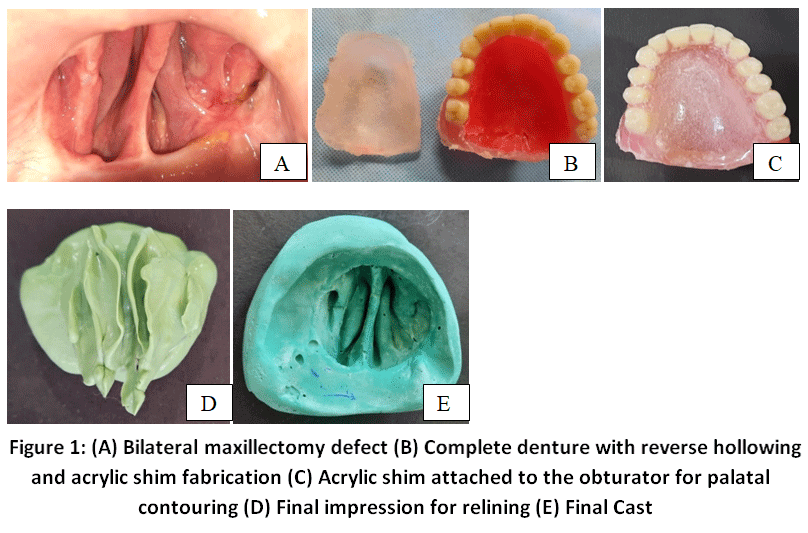 | Figure 1: (A) Bilateral maxillectomy defect (B) Complete denture with reverse hollowing and acrylic shim fabrication (C) Acrylic shim attached to the obturator for palatal contouring (D) Final impression for relining (E) Final Cast
|
The processing was done in a heat-cured resilient acrylic, Molloplast B® (Molloplast B, Regneri GmbH and Co. KG, Karlsruhe, West Germany). The final prosthesis can be seen floating in water in a rubber bowl. The definitive obturator was delivered to the patient and during the final fit, the denture was polished, and instructions were given to the patient on how to insert and remove the prostheses. Instructions regarding maintenance of the prosthesis were also explained to her. The patient’s appearance could be noticed after insertion of the obturator (Figure 2. A-C).
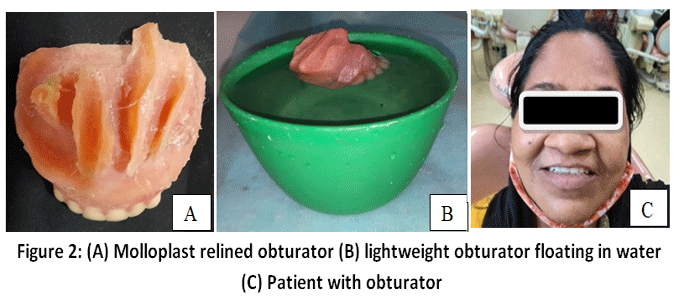 | Figure 2: (A) Molloplast relined obturator (B) lightweight obturator floating in water (C) Patient with obturator
|
The patient was recalled to check the fit of the resilient obturator intraorally at follow-ups up to 6 months, to ensure that it was able to engage the soft-tissue undercuts without traumatizing the tissues.
Objective measures such as prosthesis weight reduction, standardized fit/stability scores, and validated patient satisfaction questionnaires were not recorded. Patient feedback was obtained during routine follow-up based on comfort, retention, mastication, speech, and overall satisfaction. Therefore, the findings are descriptive.
Discussion
An obturator plays a vital role in restoring speech, mastication, and deglutition, particularly in patients with total maxillectomy defects in whom these functions are severely compromised. In extensive maxillary defects, retention of a complete denture prosthesis is highly challenging because the fundamental retentive mechanisms like adhesion, cohesion, and peripheral seal are markedly reduced due to air leakage, poor stability, and a diminished denture-bearing area. Therefore, the prosthodontist must effectively utilize the available peripheral contours and residual undercuts of the defect to maximize retention, stability, and support.7
In the present case, the obturator was initially fabricated using a conventional technique without hollowing, as direct hollowing procedures are technically difficult in extensive defects with multiple undercuts and irregular morphology. A reverse hollowing method was subsequently employed to overcome these limitations and reduce the overall weight of the prosthesis. Reduction in prosthesis weight is clinically important because a lighter obturator improves comfort, decreases gravitational dislodging forces, facilitates insertion and removal, and may enhance patient acceptance.Following hollowing, Molloplast B, a heat-cured resilient silicone liner, was used for relining the tissue surface of the obturator. This material is soft, flexible, and resilient, enabling engagement of soft-tissue undercuts without traumatizing delicate tissues. Its cushioning effect allows more favorable stress distribution at the mucosa–prosthesis interface and helps reduce displacement of the denture-bearing tissues during function.8Consequently, the resilient liner contributed to improved adaptation, comfort, and retention in the present patient.Molloplast B has been successfully used in a variety of clinical situations, including edentulous patients with bony undercuts, xerostomia, obturator relining, relief over tori and exostoses, persistent denture sore mouth, distal extension removable partial dentures, dentures opposing natural dentition, and implant-supported prostheses during the healing phase.9-11 Previous study had reported fungal colonization on soft liners in some patients with inflamed mucosa; however, no direct relationship has been established between the presence of yeast and deterioration of tissue health.12Nevertheless, meticulous oral and prosthesis hygiene remains essential, especially in patients previously treated for mucormycosis, to minimize microbial colonization and maintain tissue health.13
In the present case, the patient adapted well to the prosthesis and reported satisfactory comfort and function. However, minor ulcerations were noted during follow-up because of severe undercuts and the presence of retained turbinates, which may limit long-term tolerance of the prosthesis. For such extensive defects, the ideal definitive rehabilitation may involve quad zygomatic implants or patient-specific implant-supported frameworks. However, these treatment options may not be feasible because of financial, surgical, or systemic limitations.14 In such circumstances, the removable prosthesis or obturator with reverse hollowing technique offers an economical, practical, and clinically effective alternative for prosthetic rehabilitation.
Despite this the present report has several limitations. Prosthesis weight was not objectively quantified and was assessed only by a simple clinical floating test. Functional performance of the obturator was evaluated clinically without standardized objective outcome measures. The follow-up period was limited to 6 months, as the patient was unavailable thereafter, restricting long-term assessment. In addition, this is a single descriptive case report without control comparison; therefore, the findings should be considered preliminary and interpreted with caution, with limited generalizability to broader patient populations.
Conclusion
Several techniques have been described for fabrication of hollow definitive obturators; however, the reverse hollowing method offers a simple, time-efficient, and reproducible alternative, particularly in cases with extensive undercuts. The use of Molloplast B as a resilient liner may improve comfort, adaptability, and stress distribution in total maxillectomy patients, although maintenance challenges and occasional mucosal irritation may occur. However, as these findings are based on a single descriptive case with limited follow-up and no objective outcome measures, they should be considered preliminary and interpreted with caution.
Acknowledgement
The authors would like to acknowledge the academic guidance and institutional support provided by the Department of Prosthodontics and Crown Bridge, Maulana Azad Institute of Dental Sciences and AIIMS-CAPFIMS during the preparation of this case report. No financial support or external funding was received for this study.
Funding Sources
The author(s) received no financial support for the research, authorship, and/or publication of this article.
Conflict of Interest
The authors do not have any conflict of interest.
Data Availability Statement
This statement does not apply to this article.
Ethics Statement
Ethical approval was waived by the Institutional Ethics Committee in accordance with institutional policies. Patient confidentiality and anonymity were maintained throughout the study.
Informed Consent Statement
The authors certify that they have obtained all appropriate patient consent forms. In the form, the patient has given her consent for her images and other clinical information to be reported in the journal. The patient understands that her name and initials will not be published and due efforts will be made to conceal identity, but anonymity cannot be guaranteed.
Authors’ Contribution
Kumari Deepika: Conceptualization, Methodology, Clinical Procedure and Writing- Original Draft and editing.
Preeti Mishra: Writing- Review & Editing.
•Rekha Gupta: Supervision, Validation and Critical Review
References
- Dipalma G, Inchingolo AM, Trilli I, Ferrante L, Noia AD, de Ruvo E, Inchingolo F, Mancini A, Cocis S, Palermo A, et al. Management of Oro-Antral Communication: A Systemic Review of Diagnostic and Therapeutic Strategies. Diagnostics. 2025; 15:194.
CrossRef - Nidiffer T. J, Shipmon T.H. The hollow bulb obturator for acquired palatal openings. J. Pros. Dent.1957; 7:126-34
CrossRef - Lowery, P. C. Acrylic Hollow Bulb, Dental Survey.1952; 28:1666
- N P, Ks A, S MK, Natarajan S. Maxillary Defect Rehabilitation Using a Hollow Bulb Obturator. Cureus. 2022 Nov 10;14:e31326.
- Desjardins RP. Obturator prosthesis design for acquired maxillary defects. J Prosthet Dent.1978; 39:424-35.
CrossRef - Habib BH, Carl F. Driscoll. Fabrication of a closed hollow obturator. J Prosthet Dent. 2004; 91:383-5
CrossRef - Mittal M, Kalra A, Dabra T, Isser Y, Kumar A. Two Piece Closed Hollow Bulb Magnet Retained Obturator: A Viable Modality Option of Rehabilitation in Maxillofacial Prosthodontics- A Case Report. Int. j. oral health dent. 2015; 1:142-145
- Schmidt WF Jr, Smith DE. A six year retrospective study of Molloplast –B lined dentures. Part I: Patient response. J Prosthet Dent. 1983; 50: 308-13.
CrossRef - Agrawal, D.H., Shah, D.R., & Jhala, D.N. A Comparison between Two Ways of Relining With Soft Denture Lining Materials (An in-vitro Study ). Sch. J. App. Med. Sci., 2014; 2:61-6
- Patil AA, Kalsekar B, Kasat SJ, et al. Fabrication of Maxillary Obturator Using Combination of PEEK, Acrylic Resin, and Silicone: A Case Report. Int J Prosthodont Restor Dent. 2022;12(1):46–50.
CrossRef - Srivastava SK, Srivastava S, Shekhar A, Sarkar D, Singh A. Prosthetic Rehabilitation of a Post-mucormycosis Maxillectomy Defect Using a Maxillary Hollow Obturator and Complete Denture: A Case Report. Cureus. 2025;17(5):e83881.
CrossRef - Makila, E. and Hopsu-Havu, V.K. Mycotic growth and soft denture lining materials. Acta Odontologica Scandinavica. 1977; 35:197-205.
CrossRef - Schmidt W.F, Smith D.E. A six-year retrospective study of Molloplast-B-lined dentures. Part I: Patient response. J Prosthet Dent. 1983; 50:308-13.
CrossRef - Anantharaju A, Kamath G, Mody P, Nooji D. Prosthetic rehabilitation of Oro-nasal defect. J Indian Prosthodont Soc. 2011;11:242-5.
CrossRef