.jpg)

Evaluation of Salivary pH in Patients Before and After Scaling Treatment
Anubhava Vardhan Sharma1*  , Fazle Khuda1 , Vinay Marla2 , Anand Krishnan1 , Amirah Zahidah Binti Roslan3 and Annisatul Arrufaidhah Binti Saidin3
1Department of Restorative Dentistry, Lincoln University College, Selangor, Malaysia .
2Department of Oral Medicine and Pathology, Qaiwan International University, Sulaymaniyah Governorate, Iraq .
3Department of Dental Public Health, Ministry of Health, Malaysia .
http://dx.doi.org/10.12944/EDJ.06.0102.09
Introduction: The presence of plaque and calculus on the tooth surface can be an indicator of oral environment condition and status. Periodontal treatment plays an important role, especially in maintaining the salivary pH in a normal value. Hence, scaling treatment is expected to give a significant change to the salivary pH after the procedure. Aim: The aim of this study is to assess and compare the salivary pH before and after scaling treatment. Methodology: This was a comparative study reporting on 30 saliva samples. Samples were taken by collecting stimulated whole saliva before and after 7 days of scaling treatment. After obtaining the sample, the saliva pH was immediately tested using a portable digital pH meter. The collected data was tabulated in Microsoft Excel 2019, then it was exported to statistical software SPSS for statistical analysis to calculate the mean and p value for each category. Result: The Mean ± SD value of pre-scaling pH and post-scaling pH is 6.957 and 7.103 respectively. Results showed a significant change in salivary pH before and after scaling treatment with the p value of <0.001. The removal of plaque and calculus procedure by means of scaling treatment marked a significant change in salivary pH.
Copy the following to cite this article:
Sharma A. V, Khuda F, Marla V, Krishnan A, Roslan A. Z. B, Saidin A. A. B. Evaluation of Salivary pH in Patients Before and After Scaling Treatment. Enviro Dental Journal 2024; 6(1,2).
DOI:http://dx.doi.org/10.12944/EDJ.06.0102.09Copy the following to cite this URL:
Sharma A. V, Khuda F, Marla V, Krishnan A, Roslan A. Z. B, Saidin A. A. B. Evaluation of Salivary pH in Patients Before and After Scaling Treatment. Enviro Dental Journal 2024; 6(1,2).Available here:https://bit.ly/3IdPF2G
Download article (pdf) Citation Manager

Introduction
Saliva is a complex fluid that includes several host factors from various salivary glands. Approximately 750 ml of saliva is secreted daily in the oral cavity, in which 90% were derived from major salivary glands, 10% minor salivary glands.1 Minor salivary glands account for about 7% of saliva 2. Saliva serves a variety of roles necessary for the body's defense and functioning. One of the principal roles of saliva is maintaining the pH of oral environment. In order to maintain the pH, saliva uses two different methods. Saliva flow primarily aids in the removal of carbohydrates that bacteria can digest. Second, saliva's buffering properties counteract the acidity of meals and beverages as well as bacterial activity.2
The degree of acidity or alkalinity of an aqueous solution is known as salivary pH.3 Average pH of saliva is 6.7, with a normal pH range between 6.2-7.6 2. As bacteria break down the carbohydrates, they release acids which bring down the pH of saliva. When the pH level in the oral cavity goes below 5.5 (critical pH value), the acids begin to break down the enamel on teeth and cause dental caries. Meanwhile, a high pH above 7.6 promotes the formation of crystals of the biofilm that favors the development of periodontal disease.3
Periodontal disease is characterized as an inflammatory condition affecting the supporting tissues of the teeth, induced by a group of microorganisms or specific pathogens. This leads to the progressive deterioration of the periodontal ligament and alveolar bone, accompanied by phenomena such as recession, pocket formation, or both.4 The disease involves intricate host-parasite interactions, resulting in inflammation of the gingiva, destruction of the periodontal ligament, resorption of alveolar bone, and detachment of connective tissue. Following dental caries, periodontitis most prevalent oral disorder, impacting approximately 15% of the adult population.5 The course of periodontitis typically follows a cyclic pattern of remission and exacerbation, dictated by the activity or inactivity of the disease.
Dental plaque and calculus are the major etiological factors for periodontal disease.6 Plaque initiates gingival inflammation, which progress to pocket formation and periodontal destruction.7 Studies on the microbial etiology of periodontal diseases have revealed that a number of bacteria frequently detected in plaque from adult periodontitis lesion; including Porphyromonas gingivalis which grows at a pH of 6.5-7.0, Fusobacterium nucleatum grows at a pH of 5.5-7.0 and Prevotella intermedia grows at a pH of 5.0-7.0. These bacteria can produce base and neutralize acid which contributes to maintenance of plaque pH to be suitable for periodontopathic bacteria, in addition to producing large amounts of acids which have the potential to harm periodontal tissues.8
With the aim to minimizing the continuous risk to the periodontal tissues, nonsurgical treatment of patients with gingivitis and periodontitis by means of scaling and root planning is indicated.9 The objectives are to remove not only the calculus deposits, but also the attached and unattached bacterial plaque which may affect the pH of the saliva, as aforementioned. Therefore, it is logical to evaluate the changes in salivary pH before and after scaling treatment in an effort to educate the patients further regarding the detrimental effect of low and high pH of saliva to the oral cavity environment.
A study on salivary pH by Baliga S. et al. (2013) showed that the salivary pH was more alkaline for patients with generalized chronic gingivitis as compared with the control group, whereas patients with generalized chronic periodontitis had more acidic pH as compared with the control group.2 Another study found that both healthy people and those with moderate gingivitis keep their salivary pH in the neutral range. Periodontitis patients, on the other hand, have an alkaline pH. Among these individuals, 30% had a salivary pH surpassing 7.6 prior to treatment, and 75% observed a drop after periodontal therapy. Similar results were reported by authors such as Orozco et al (2020), who found a salivary pH of 6.9 in healthy patients, while patients with gingivitis and periodontitis had average values of 7.3 and 7.9, respectively.2 Following treatment, out of 60 patients, 40 responded satisfactorily, demonstrating a significant reduction in salivary pH.
In accordance with these, a hypothesis arises, the salivary pH pre-scaling treatment will exhibit either a low or high pH depending on the periodontal condition of the patient and returns to its normal pH range after scaling treatment.
Materials and Methods
Study Population
This comparative study was conducted corresponded to patients who attended the Department of Periodontics, Lincoln University College Malaysia after obtaining the institutional approval (LUCFD2023RPA08) . The inclusion and exclusion criteria for selecting patients were:
Inclusion criteria
Patient age: 18-60
Patients attending scaling treatment in LUC Dental Centre from July 2023 until August 2023.
Non-smoker, non-tobacco user, non-vapers
No systemic complication
Exclusion criteria:
Patient who are smokers, tobacco users, vapers,
Patient under any medication,
Patient with systemic complication that might affect the salivary pH and
Patients those are unwilling to be a part of the research
The study involved 30 participants whom are indicated for scaling and polishing treatment in Dental Faculty, Lincoln University College. The study's aim will be verbally described to each patient, and the patient will affirm their voluntary participation in the study by signing an informed agreement. There is no exclusion of patient whom will be participating in the study unless the patient who are not consent to.
Data Collection Tool
Digital pH meter (Specification: TDS – Total Dissolved Solid)
Portable test tube
Paraffin wax
Sampling of saliva
The patient is encouraged not to eat or drink anything other than water for one hour before the test session, and smoking, chewing gum, and coffee consumption is also forbidden during this time. Before the exam, the patient should rinse their mouth multiple times with distilled water and relax for five minutes. For the collection of stimulated whole saliva the subject sits motionless, leans forward over a funnel, swallows to clear the mouth, and then chews paraffin wax in sync with a metronome (approximately 70 strokes per minute) 10. Every minute, the subject spits saliva into a tube without swallowing while being instructed. The initial two-minute collection is dumped into a paper cup, followed by a three-minute collection. At the end, the patient spits out both saliva and paraffin wax into the tube, and the wax is removed before measuring saliva pH. Samples are taken twice: once before scaling treatment (Sample #1) and again seven days after scaling treatment (Sample #2). Each patient undergoes treatment by their designated operator under the supervision of a periodontist.
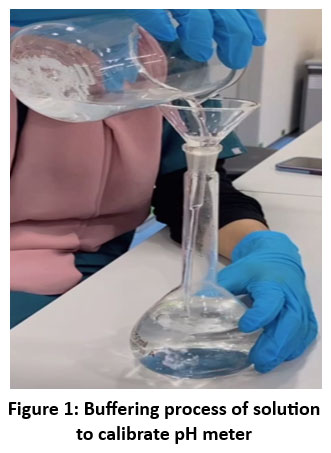 | Figure 1: Buffering process of solution to calibrate pH meter |
Salivary pH measurement
When the sample is collected, the salivary pH is instantly determined using a portable digital pH meter. Every day, we calibrate the pH meter. The electrode is immersed in 0.1 N of hydrochloric acid overnight. The pH meter is then calibrated with newly manufactured buffers at pH 7 and pH 4. The latter is used to make more precise pH adjustments. The electrode is then dipped in double distilled water. Before dipping the electrode in the sample, it is gently dried entirely on fresh sterile filter sheets. After evaluating the pH, the electrode tip is cleaned with a moderate stream of distilled water before being submerged in double distilled water. Each day, the liquids and chemicals are freshly manufactured.
Table 1: Constant pH value for acid and base for calibrating pH meter
Buffer Solution | Constant pH value |
Base | 4.00 |
Acid | 7.00 |
Statistical analysis
IBM SPSS Data Editor version 23.0 (IBM, USA) was used to perform the analysis of raw data and the values were shown as the mean and standard deviation. The paired T-test was performed to assess the difference between group mean and a level of less than 0.05 was determined.
Results
The research aimed to assess the salivary pH of patients before scaling treatment, measure the salivary pH after scaling treatment and compare the salivary pH before and after scaling treatment. The average salivary pH before scaling treatment was 6.9570±0.53767, while the average salivary pH 7 days after scaling treatment was 7.1033±0.40375. The standard deviation for the pre-scaling pH measurements was indicating the fluctuation of pH levels among participants before the treatment, whereas the standard deviation for the post-scaling pH measurements was showing a slightly lower variability among participants after the treatment. The p value for both pre-scaling and post-scaling pH is listed as <0.001. Results are shown in Table 2.
Table 2: Analysis of salivary pH before and after scaling treatment
N | Mean | Standard deviation | p Value | |
Pre-scaling pH | 30 | 6.9570 | 0.53767 | <.001 |
Post-scaling pH | 7.1033 | 0.40375 | <.001 |
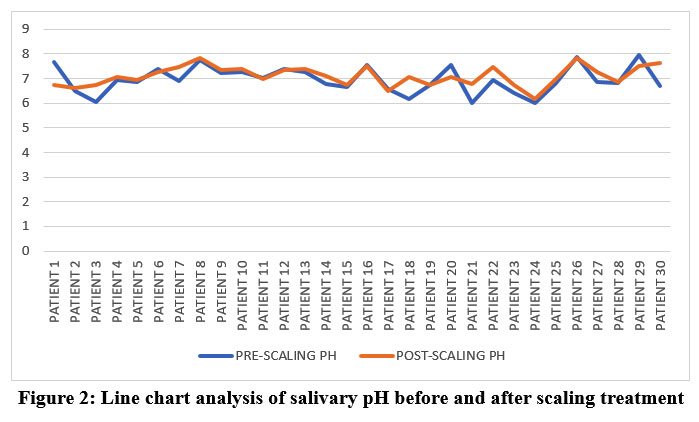 | Figure 2: Line chart analysis of salivary pH before and after scaling treatment |
Based upon our observation on the Figure 2, both the blue line (pre-scaling pH) and the red line (post-scaling pH) show fluctuations across the 30 patients. However, the overall trend suggests that the post-scaling pH is generally higher than the pre-scaling pH for most patients. Each pair of bars as shown in Figure 3 represents the pre-scaling (blue) and post-scaling (orange) pH values for an individual patient. There is variability in the pH values among the patients, which is expected in any biological measurement. For the majority of the patients, the post-scaling pH values are higher than the pre-scaling pH values.
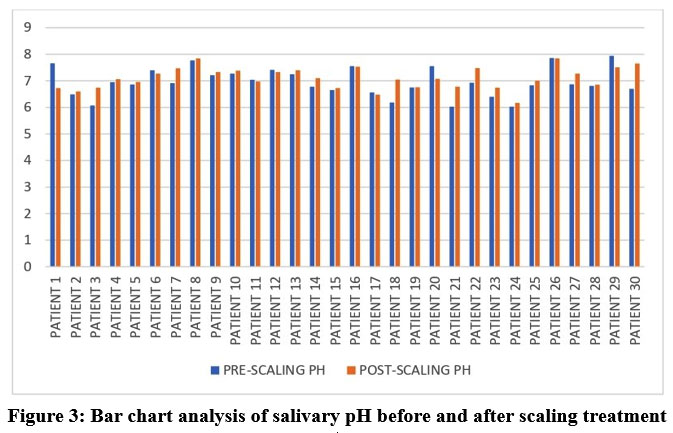 | Figure 3: Bar chart analysis of salivary pH before and after scaling treatment |
Discussion
Salivary pH is important in creating a suitable environment for enamel remineralization, controlling the rate of demineralization, and preventing the development of dental caries and periodontal disease. The examination of salivary pH has been explored for its potential role in monitoring or serving as a supplementary tool in diagnosing various oral diseases. In this research, paraffin wax is used as a saliva activator as it did not show any appreciable changes in buffering properties as determined by comparison of before meal and a period similar to that taken for after meal. In addition, it is also indicating there is no appreciable changes in saliva pH for the first and five-minute of saliva sample. During the test period, however, changes were observed which were paralleled by changes in bicarbonate concentration. No consistent relation was found between HCO3, Na+, and K+ concentrations and volume of sample. A study conducted on 2004 comparing pH changes in stimulated saliva using various kind of chewing gum such as free-sugar and sugared chewing gum including paraffin wax expressed the smallest pH changes was seen when paraffin wax is used.11
The results of the research, as indicated by the paired sample statistics table, showed a statistically significant change in the difference of salivary pH before and after scaling treatment. The pre-scaling saliva samples had an average pH of 6.96 ± 0.54, which increased to 7.10 ± 0.40 after 7 days post-scaling. The p value of <0.001 indicated that this difference was highly unlikely to have occurred by chance. According to a study proposed by Baliga S. et al., a salivary pH above 7.0 generally signifies alkalinity, and excessive alkalinity can create anaerobic conditions. In such instances, the biofilm extracts calcium compounds from the oral environment and employs minerals to shield itself from the elevated pH. A pH exceeding 7.6 fosters the crystalline formation of the biofilm, promoting the onset of periodontal disease. Conversely, a low pH encourages tooth structure demineralization and supports the proliferation and metabolism of acidogenic and acid-tolerant bacteria, simultaneously inhibiting many beneficial resident species.2
A 2021 study investigating pH changes in patients with periodontal disease associated with cardiovascular disease reveals notable shifts in saliva pH values from 6.25 up to 6.30 ± 0.17 after oral hygienization.12 Furthermore, a comparison of mean values between patients with periodontal disease and those with healthy gingiva reveals a noteworthy disparity in salivary pH following periodontal treatment. In gingivitis patients, the pH undergoes a shift from 7.21 ± 0.11 to 7.51 ± 0.88, while 6.82 ± 0.27 towards 7.24 ± 0.23 in periodontitis patient 13. This aligns with our own study, which similarly demonstrates substantial changes in salivary pH before and after scaling from 6.96 ± 0.54 to 7.10 ± 0.40 approaching alkaline value. Furthermore, a similar study by Koppolu et al. (2022), it is stated the mean pH for healthy gingiva was 7.60 ± 0.21. Another study was conducted on 2022 comparing the salivary pH between the patients with healthy gingiva, gingivitis and periodontitis. The study reveals the mean salivary pH was 7.00 ± 0.18, 6.58 ± 0.58 and 6.24 ± 0.11 respectively.14 This strengthens our research results in which the post-scaling treatment pH manifests alkalinity with the value of 7.10 ± 0.40.
The research findings align with the literature, as an increase in salivary pH approaching a neutral value (pH 7.0) after scaling treatment suggests a positive impact on oral health. Scaling treatment aims to remove plaque and calculus, which can contribute to dental caries, periodontal disease, and alterations in salivary pH. The removal of these deposits through scaling treatment may help restore a more neutral salivary pH and create a healthier oral environment.
Post-scaling pH measurements were scheduled 7 days after the scaling treatment. Saliva was assessed using a pH meter within 1 hour of sample collection, which could have led to alterations in pH, consistency, and content. Temperature was found to positively influence salivary pH, affecting the performance of the pH meter’s sensor, as temperature changes reduce electrode accuracy and speed. Standardizing the temperature during pH evaluation would minimize procedural errors and improve the reliability of the results. The research on salivary pH before and after scaling provides valuable insights into how scaling treatment impacts pH levels. The findings suggest that scaling significantly increases salivary pH, potentially creating a healthier oral environment. However, larger studies with control groups are needed to confirm these results and explore other factors affecting salivary pH. Pre- and post-scaling pH values ranged from approximately pH 6 to 8, with post-scaling values often closer to or above neutral pH (7). Although the general trend showed an increase in pH after scaling, individual variations were observed. Some patients experienced a pronounced increase, while others had a more modest change. A few cases showed that post-scaling pH was slightly lower or the same as pre-scaling levels. However, the overall trend suggests that scaling systematically increases salivary pH, which was supported by a previous table indicating a p-value of <0.001, suggesting the differences were statistically significant.
The findings of the current study indicate that scaling treatment has a significant positive effect on salivary pH, with values increasing from an average of 6.96 to 7.10. Most patients showed a shift towards neutral pH, which is associated with a healthier oral environment, supporting enamel remineralization and inhibiting harmful bacteria. Although a few patients showed little or no change, the overall trend demonstrated that post-scaling pH values were generally closer to or above neutral. These findings suggest that scaling contributes to improved oral health by creating conditions more favorable for maintaining balance in the oral ecosystem.
Conclusion
Supra-gingival plaque control reduced periodontal pathogens and scaling shifted salivary pH towards alkaline, creating a healthier oral environment. Low pH favours enamel demineralization and pathogenic bacteria, while the observed post-scaling shift suggests protective benefits. However, the study was limited by a small sample size, lack of control group, and exclusion of factors such as systemic health, age, diet, and oral hygiene. Future research with larger, controlled samples is recommended.
Acknowledgement
The authors would like to thank Faculty of Dentistry, Lincoln University College, Malaysia for helping in conducting the research.
Funding Sources
The author(s) received no financial support for the research, authorship, and/or publication of this article.
Conflict of Interest
The authors do not have any conflict of interest.
Data Availability Statement
This statement does not apply to this article.
Ethics Statement
This research did not involve human participants, animal subjects, or any material that requires ethical approval
Informed Consent Statement
This study did not involve human participants, and therefore, informed consent was not required.
Authors Contribution
Anubhava Vardhan Sharma, Amirah Zahidah Binti Roslan, Annisatul Arrufaidhah Bt Saidin conducted the research. Fazle Khuda, Anand Krishnan wrote the manuscript and analyze the data. Vinay Marla reviewed the manuscript and contributed to the methodology.
- Pedersen & Belstrom. The role of natural salivary defences in maintaining a healthy oral microbiota. J Dent. 2019; 80: S3-S12. https://doi.org/10.1016/j.jdent.2018.08.010
CrossRef - Baliga, S., Muglikar, S., & Kale, R. Salivary pH: A diagnostic biomarker. J. Indian Soc Periodontol. 2013; 17(4): 461–465. https://doi.org/10.4103/0972-124X.118317
CrossRef - Orozco Páez, J., Contreras de la Rosa, L., & López Banda, J. Salivary pH as an improvement parameter in patients with periodontitis: A pilot study. Ciencia e Innovación En Salud 2020. https://doi.org/10.17081/innosa.87
CrossRef - Beck J. D, Philips K, Moss K, et al. Periodontal disease classifications and incident coronary heart disease in the atherosclerosis risk in communities study. J Periodontol. 2020; (91): 1409–1408.
CrossRef - Khuda F., Anuar, N. N. M., Baharin, B., Nasruddin, N. S. A mini review on the associations of matrix metalloproteinases (MMPs) -1, -8, -13 with periodontal disease. AIMS Mol Sci. 2021;8(1): 13–31.
CrossRef - Shibly, O., Rifai, S. and Zambon, J. J. Supragingival dental plaque in the etiology of oral diseases. Periodontol 2000. 1995;8:42-59. https://doi.org/10.1111/j.1600-0757.1995.tb00044.x
CrossRef - Jha, D., Narayan S. J., & Yadalam, U. Influence of Salivary PH and Urea Level on Calculus Formation – A Clinico – Biochemical Study. RJDS, 2021; 13(1): 2-6.
CrossRef - Takahashi’, N., Saltol, K., Schachtele, C. F., Yamada’, T., & Takahashi, N. Acid tolerance and acid-neutralizing activity of Porphyromonas gingivalis, Prevotella intermedia and Fusobacterium nucleatum. Oral Microbiol Immunol. 1997;12:323–328.
CrossRef - Khattri S., Kumbargere Nagraj S., Arora A., Eachempati P., Kusum C. K., Bhat K. G., Johnson T. M., Lodi G. Adjunctive systemic antimicrobials for the non-surgical treatment of periodontitis. CDSR 2020; 11: CD012568.
CrossRef - Navazesh, M., & Kumar, S. K. S. Measuring salivary flow. JADA. 2008;139:35S-40S. https://doi.org/10.14219/jada.archive.2008.0353
CrossRef - Nuca, C., Amariei, C., & Constanta, R. Clinical study regarding the influence of the sugared and sugar-free chewing gum on the salivary pH and flow rate. Oral Health Dent Manag. 2004, III(2).
- Lazureanu, P. C., Popescu, F., Tudor, A., Stef, L., Negru, A. G., & Mihaila, R. Saliva pH and Flow Rate in Patients with Periodontal Disease and Associated Cardiovascular Disease. Med Sci Monit. 2021; 27: e931362. https://doi.org/10.12659/MSM.931362
CrossRef - Koppolu, P., Sirisha, S., Penala, S., Reddy, P. K., & Alotaibi, D. H., et al. Correlation of Blood and Salivary pH Levels in Healthy, Gingivitis, and Periodontitis Patients before and after Non-Surgical Periodontal Therapy. Diagnostics. 2022;12(1): 97. https://doi.org/10.3390/diagnostics12010097
CrossRef - VPRB, R. R., & Thamaraiselvan, M. Role of Salivary PH on the Prevalence of Periodontal Disease: A Cross Sectional Pilot Study. JRMDS. 2020; 8(7): 423–427.