.jpg)

A Cross-Sectional Survey of Patient and Dentist Attitudes Toward Tele-Orthodontics
Reyaam Mutaz Sabri Alrawi1  and Goksu Trakyali2*
1Department of Orthodontics, Faculty of Dentistry, Yeni Yüzyil University, , Istanbul, Turkey .
2Department of Orthodontics, Faculty of Dentistry, Istanbul Atlas University, Istanbul, Turkey .
http://dx.doi.org/10.12944/EDJ.06.0102.08
This study aimed to evaluate the awareness, attitudes, and readiness of patients, general dentists, and orthodontists toward tele-dentistry, with a particular focus on its utility in diagnostics and emergency care.
A cross-sectional survey was conducted among 400 participants, including 200 patients and 200 dental clinicians (100 general dentists, 100 orthodontists). Two validated questionnaires (23 items each) assessed awareness, preferences, and expectations regarding tele-dentistry. Sampling was random for patients attending Yeni Yüzy?l University Orthodontic Department, while clinicians were recruited from private practice settings. Descriptive statistics, chi-square tests, and Spearman correlation were performed using SPSS v25, with p<0.05 considered significant.
A total of 45.5% of the patients were unaware of tele-dentistry. Awareness was not associated with educational level (p>0.05). General dentists reported significantly higher previous use of tele-dentistry than orthodontists (p<0.001). Most patients (68.5%) believed tele-dentistry would shorten treatment duration, and 51.5% perceived financial benefits. Differences emerged between clinicians’ expectations and patients’ willingness to schedule remote initial diagnostic visits (p=0.001).
Tele-orthodontics demonstrates potential for improving access to care, particularly in emergencies and rural contexts. However, limited patient awareness remains a critical barrier. While financial and time-saving benefits are acknowledged, clinicians remain cautious about its applicability in orthodontics.
Tele-dentistry can complement traditional practice, especially for monitoring and triage, but widespread adoption requires targeted educational campaigns, updated training curricula, and stronger integration of digital health tools.
Copy the following to cite this article:
Alrawi R. M. S, Trakyali G. A Cross-Sectional Survey of Patient and Dentist Attitudes Toward Tele-Orthodontics. Enviro Dental Journal 2024; 6(1,2).
DOI:http://dx.doi.org/10.12944/EDJ.06.0102.08Copy the following to cite this URL:
Alrawi R. M. S, Trakyali G. A Cross-Sectional Survey of Patient and Dentist Attitudes Toward Tele-Orthodontics. Enviro Dental Journal 2024; 6(1,2).Available here: https://bit.ly/472DuOz
Download article (pdf) Citation Manager

Introduction
The integration of digital health into dentistry has advanced significantly. Recent reviews highlight tele-dentistry’s role as an inclusive approach across specialties—general dentistry, periodontics, orthodontics, and public health—by improving access to care and enabling remote triage, consultation, and monitoring¹. Tele-dentistry also enhances patient–clinician communication, care quality, and overall patient experience².
In orthodontics, evidence shows that tele-dentistry—especially using systems like Dental Monitoring®—can reduce the number of in-person appointments and shorten refinement phases in aligner therapy, though evidence certainty remains low³.
Furthermore, systematic reviews confirm that digital communication tools—such as reminders and audiovisual messaging—improve oral hygiene and appointment compliance in orthodontic patients?.
In rural areas, most low-income families live pay check to pay check, making it challenging for parents to afford orthodontic visits. Additionally, many must travel long distances to find an orthodontist, often missing work or school to attend appointments. As a result, many low-income children go without necessary orthodontic treatment and enter adulthood with dental issues that can negatively impact their quality of life and self-perception.
Tele-orthodontics is also expanding in education: a recent study supports integrating tele-dentistry preparation into orthodontic curricula, emphasizing remote follow-up, monitoring, and interdisciplinary collaboration?.
Aim: This study aimed to evaluate awareness, attitudes, and experiences of patients, general dentists, and orthodontists towards tele-dentistry, focusing on its role in remote diagnostics and emergency management.
Materials and Methods
The sample size was determined using G*Power 3, which indicated a minimum of 200 responses per group based on a moderate correlation. The cross-sectional survey included 400 participants: 200 dentists (65.5% male, 34.5% female), subdivided into 100 orthodontists and 100 general dentists in private practice setting, and 200 randomly selected active patients from the Yeni Yüzy?l University Dental Hospital Orthodontic Department’s patient list (29.0% male, 71.0% female). Inclusion criteria comprised patients aged 18–40 years who were undergoing active orthodontic treatment, had regular internet access, and were willing to participate by providing informed consent. Exclusion criteria included patients with systemic or psychological conditions that could interfere with survey participation, those who had previously completed orthodontic treatment, individuals lacking sufficient digital literacy or access to online platforms, and respondents with incomplete or inconsistent questionnaire data.
Two distinct questionnaires were developed as the Professional’s Questionnaire (PrQ) and the Patient’s Questionnaire (PaQ), designed to explore the correlation between patient awareness and dentist expectations regarding the use of tele-dentistry. Both questionnaires were distributed over a three-month period, from June 16, 2022, to September 16, 2022. These questionnaires were adapted from a previous study by Boringi et al.6 and consisted of two sections. Section A collected descriptive information from both dentist and patient groups, while Section B of the PrQ focused on dentists' expectations regarding tele-dentistry use and their perceptions of patients. In the PaQ, Section B examined patient awareness of social media use, familiarity with tele-dentistry, electronic abilities, preferences for future tele-dentistry use, concerns about security and privacy, and their perceived ability to take intraoral photographs using two spoons or fingers (Figure 1). Written consent has been taken from the model used in Figure 1.
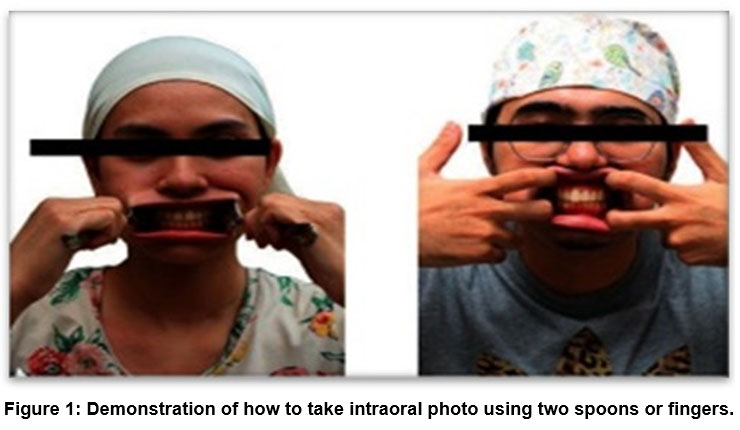 | Figure 1: Demonstration of how to take intraoral photo using two spoons or fingers.
|
Reliability and Validity
Cronbach’s ? was 0.67 and self-reported validity testing was 0.82. Although ? was slightly below the conventional threshold of 0.70, values above 0.60 are acceptable in exploratory social research. This limitation was acknowledged.
Statistical Analysis
Data were analyzed using SPSS v25. Descriptive statistics summarized responses. Chi-square tests examined group differences, while Spearman correlation assessed ordinal relationships. Statistical significance was set at p<0.05.
This questionnaire study did not involve experiments on humans or animals. Written informed consent was obtained from all participants prior to their inclusion in the study. All participants were provided with instructions on completing the survey. The study design conforms to the standards currently applied in the country of origin. Ethical approval was obtained from the Ethics Committee of Istanbul Yeni Yüzy?l University. The study was performed in accordance with the ethical principles of the Declaration of Helsinki and its subsequent amendments.
Results
The results revealed no statistically significant difference between patients’ awareness of tele-dentistry and dentists’ expectations regarding their patients' prior knowledge of tele-dentistry (Table 1). Among the patients, 45.5% reported that they were unaware of tele-dentistry, while dentists predicted low patient awareness (47%), closely matching actual results.
Table 1: Relation between patients’ awareness and dentists’ expectations about their patient’s knowledge about tele-dentistry.
Patients’ awareness about tele-dentistry | Dentists (n=200) | Patients (n=200) | Chi-Square | P-value | Sig. | ||
n | % | n | % | ||||
Disagree | 94 | 47% | 91 | 45.5% | 0.631 | 0.73 | NS |
Not sure | 55 | 27.5% | 62 | 31% | |||
Agree | 51 | 25.5% | 47 | 23.5% | |||
NS: not significant; *: p?0.05; **: p?0.01; ***: p?0.001. | |||||||
General dentists reported significantly higher tele-dentistry use than orthodontists (p<0.001)(Table 2).
Table 2: Relation between orthodontists and all other dentists on having treated their patients remotely before.
Have you treated your patients remotely before? | Orthodontists (n=100) | General Dentists (n=100) | Chi-Square | P-value | Sig. |
Disagree | 75 | 18 | 75.886 | 0.00 | *** |
One Time | 2 | 42 | |||
Agree | 23 | 40 | |||
NS: not significant; *: p?0.05; **: p?0.01; ***: p?0.001. | |||||
Tele-dentistry combined with traditional orthodontic treatment was reported as believed to shorten the treatment period by 68.5% of patients (Table 3). Regarding time saving, only 18.5% of patients did not agree that tele-dentistry would be beneficial in terms of time savings (Table 4). For costs, 19% of patients believed that tele-dentistry would have no impact on saving money, while 29% believed it would save at least a little, and 51.5% thought it would save a significant amount (Table 5).
Table 3: Patients' perception about treatment period while treated remotely in addition to traditional methods.
Do you believe that combining remote care with traditional treatment will shorten your treatment time? | n | Percentage (%) |
Yes | 137 | 68.5% |
Not sure | 0 | 0 |
No | 63 | 31.5% |
Total | 200 | 100% |
Table 4: Patients' perception of time savings when treated remotely.
Do you believe that receiving remote treatment could save you time? | n | Percentage (%) |
Totally sure | 72 | 36% |
A little | 91 | 45.5% |
No | 37 | 18.5% |
Total | 200 | 100% |
Table 5: Patients' perception of the potential cost savings when treated remotely.
Do you believe that you could save money by receiving remote treatment? | n | Percentage (%) |
Yes | 59 | 29.5% |
Small saving | 103 | 51.5% |
No | 38 | 19% |
Total | 200 | 100% |
Significant differences were found between clinicians’ and patients’ expectations for remote initial visits (p=0.001) (Table 6). In both groups, 43.5% participants agreed tele-dentistry could manage minor emergencies, though dentists expressed greater reservations. (Table 7). Educational level was not significantly associated with awareness (p>0.05).
Table 6: Comparison between patients' preferences for scheduling their initial diagnostic appointment remotely and dentists' expectations regarding these preferences.
Patients’ willingness of preferring remote care for initial diagnostic appointment | Dentists (n=200) | Patients (n=200) | Chi-Square | P-value | Sig. | ||
n | % | n | % | ||||
Disagree | 54 | 27% | 69 | 34.5% | 13.458 | 0.001 | *** |
One Time | 58 | 29% | 78 | 39% | |||
Agree | 88 | 44% | 53 | 26.5% | |||
NS: not significant; *: p?0.05; **: p?0.01; ***: p?0.001. | |||||||
Table 7: Comparison between patients' beliefs regarding their dentist's ability to manage minor emergencies through tele-dentistry and dentists' perceptions of these beliefs.
Ability of dentists to manage minor emergencies through tele-dentistry | Dentists (n=200) | Patients (n=200) | Chi-Square | P-value | Sig. | ||
n | % | n | % | ||||
Disagree | 51 | 25.5% | 25 | 12.5% | 13.401 | 0.001 | *** |
Some of them | 62 | 31% | 88 | 44% | |||
Agree | 87 | 43.5% | 87 | 43.5% | |||
NS: not significant; *: p?0.05; **: p?0.01; ***: p?0.001. | |||||||
Discussion
Findings echo broader trends: despite high perceived utility, patient awareness of tele-dentistry remains low—paralleling observations in Jeddah, Saudi Arabia, where >70% of patients believed tele-dentistry saves time and money, and >60% of dentists recognized its benefits7.
Systematic data from the COVID-19 era show dental practitioners had high awareness (70%) and favourable attitudes (72%) toward tele-dentistry, though actual use remained low (36%)8. This mirrors our findings: clinicians support the concept, but uptake was limited—particularly among orthodontists.
Tele-dentistry positively impacts quality of care across settings, with enhanced communication, remote diagnosis, and reduced patient burden2, 9.
Evidence from orthodontic studies supports its applicability: tele-dentistry decreases in-person visits, especially in aligner-based therapies³. Meanwhile, digital tools like reminders and audiovisual messaging improve patient compliance?.
Furthermore, tele-training models for orthodontic care—covering emergency management and interdisciplinary coordination—reinforce the need for remote modalities beyond pandemic-era constraints?.
Limitations
This study had limitations: the Cronbach’s ? was below the commonly accepted threshold of 0.7, reflecting moderate internal consistency. The cross-sectional design precludes causal inference, and convenience sampling may limit generalizability. The results of the study cannot be attributed to the whole dental population. Future multicentre studies with larger samples and qualitative components are warranted.
Conclusion
Tele-dentistry offers a valuable complement to traditional practice, particularly in monitoring, triage, and emergency care. While patients generally recognize its advantages, limited awareness and clinician hesitancy impede broader adoption. Integrating tele-dentistry into dental curricula, launching public awareness campaigns, and developing user-friendly platforms could accelerate acceptance.
A hybrid model combining in-person and remote care may represent the future of orthodontics, especially for younger, digitally literate populations.
Acknowledgement
The authors would like to thank the staff of Yeni Yuzyil University Dental Hospital who have provided help during the work
Funding Sources
The author(s) received no financial support for the research, authorship, and/or publication of this article.”
conflict of Interest
The authors do not have any conflict of interest
Data Availability Statement
This statement does not apply to this article
Ethics Statement
This research did not involve human participants, animal subjects, or any material that requires ethical approval.
Informed Consent Statement
This study did not involve human participants, and therefore, informed consent was not required
Clinical Trial Registration
This research does not involve any clinical trials.
Permission to material reproduce from other sources
All Tables and Figures used in this manuscript are original to the research and have not been adapted from any other previously p?blished work.
Authors’ Contribution
Reyaam Mutaz Sabri Alrawi: Investigation, Conceptualization, Methodology, Investigation, Resources, Data Curation, Writing - Original Draft, Methodology, Validation, Formal analysis,
Goksu Trakyal?: Data Curation. Writing - Review & Editing, Visualization, Supervision, Project administration, Writing - Review & Editing.
References
- Hamdy TM. Teledentistry: a comprehensive review of applications, challenges, and future directions. Discover Med. 2025;2:201. doi:10.1007/s44337-025-00445-z.
CrossRef - Amy JL, Valerio C, Di Giandomenico D, Fani E, Leonardi R, Marzo G. Teledentistry for improving access to, and quality of oral health care: overview of systematic reviews and meta-analyses. J Med Internet Res. 2025;27:e65211. doi:10.2196/65211.
CrossRef - Torres DKB, Santos MCC, Normanddo D. Is teledentistry effective to monitor the evolution of orthodontic treatment? A systematic review and meta-analysis. Dental Press J Orthod. 2023;28(4):e2322195. doi:10.1590/2177-6709.28.4.e2322195.
CrossRef - Kotish S, Nanda SB, Mishra S, Nayak TK. Usefulness of smartphone-based communication in improving oral hygiene in patients undergoing orthodontic treatment: systematic review and meta-analysis. Int J Health Sci. 2022;6(S3): 1426-1431. doi: 10.53730/ijhs.v6nS3.5604.
CrossRef - Akçiçek G, Kat? E, Zengin HY. Evaluation of undergraduate dental students’ awareness and attitudes towards teledentistry: does a course enhance this? BMC Med Educ. 2025;25:160. doi:10.1186/s12909-025-06758-y.
CrossRef - Boringi M, Mehta A, Singh S, et al. Knowledge and awareness of teledentistry among dental professionals – a cross-sectional study. J Clin Diagn Res. 2015;9(8):ZC41–ZC44. doi: 10.7860/JCDR/2015/13303.6320.
CrossRef - Alshammari A, Almaktoom I. Teledentistry Awareness and Knowledge Among Dental Practitioners and Patients in Jeddah, Saudi Arabia. Clin Cosmet Invesrig Dent. 2023;29(15):321–331. doi:10.2147/CCIDE.S427142.
CrossRef - Lin GSS, Koh SH, Ter KZ, Lim CW, Sultana S, Tan WW. Awareness, knowledge, attitude, and practice of teledentistry among dental practitioners during COVID-19: a systematic review and meta-analysis. Medicina. 2022;58(1):130. doi:10.3390/medicina58010130.
CrossRef - Surdu A, Foia CI, et al. Teledentistry and digital tools in dentistry: enhancing diagnosis and patient care. Medicina. 2025;61(5):826. doi: 10.3390/medicina61050826.
CrossRef