.jpg)

Effectiveness of Ultrasonic and Manual Dynamic Agitation Technique Using Different Irrigants: An in Vitro Study
Sajal Chaudhary*  , Pankaj Mishra , Santosh Kumar Singh , Muskan Sitlani , Savarna Goswami and Avneel Neema
1Department of Conservative and Endodontics, People College of Dental Sciences and Research Center, Bhopal, Madhya Pradesh India. .
http://dx.doi.org/10.12944/EDJ.05.02.05
In endodontic treatment, irrigation is frequently considered the most crucial step, especially when it comes to eliminating root canal microorganisms. As irrigation performs a number of crucial tasks, some of which may change depending on the type of irrigant used: it lessens dentine and instrument friction, enhances file cutting efficiency, dissolves tissue, cools the file and tooth ,it also has antimicrobial, anti biofilm and washing properties. Furthermore, irrigation is the sole way to treat the areas of the root canal wall that are inaccessible to mechanical tools. A range of delivery techniques, such as machine-driven devices and the traditional syringe-needle administration system are used for root canal irrigation.
Copy the following to cite this article:
Chaudhary S, Mishra P, Singh S. K, Sitlani M, Goswami S, Neema A. Effectiveness of Ultrasonic and Manual Dynamic Agitation Technique Using Different Irrigants: An in Vitro Study. Enviro Dental Journal 2023; 5(2).
DOI:http://dx.doi.org/10.12944/EDJ.05.02.05Copy the following to cite this URL:
Chaudhary S, Mishra P, Singh S. K, Sitlani M, Goswami S, Neema A. Effectiveness of Ultrasonic and Manual Dynamic Agitation Technique Using Different Irrigants: An in Vitro Study. Enviro Dental Journal 2023; 5(2). Available here:https://bit.ly/3AejwUu
Download article (pdf) Citation Manager

Introduction
A root canal treatment cannot be successful unless all necrotic and vital pulp tissue, bacteria, and their poisons are removed.1 Sufficient disinfection during root canal therapy requires appropriate apparatus in conjunction with efficient irrigation.2 During biomechanical endodontic treatment, irrigation fluids primarily serve as lubricants and cleaning agents, increasing the canals permeability over its whole length and removing contaminated dentin.3
The two main types of root canal irrigation delivery and agitation systems are machine-assisted agitation devices and manual agitation procedures. Positive pressure irrigation, which is often done using a syringe and a side-vented needle, is a type of manual irrigation. The activation of the irrigant has been reported as being easy and reasonably priced when done with manual dynamic agitation (MDA). It entails repeatedly inserting a gutta-percha cone that fits well into the working length of a canal that has already been formed. Conversely, there are machine-assisted irrigation methods like ultrasonic and sonic irrigation. Passive ultrasonic irrigation (PUI) is the use of an ultrasonically activated file or tip for activating an irrigant; it is not utilized for canal preparation.1 One potential answer to the issue of debriding and disinfecting the root canal system is the use of ultrasonic. It has been demonstrated that using ultrasonic after hand or rotary instrumentation is finished reduces the amount of microorganisms.
Furthermore, a considerably greater proportion of canals (80%) did not grow any bacteria after the addition of ultrasonic irrigation compared to 27% after hand/rotary instrumentation alone.4 With the use of an ultrasonic device and acoustic energy, this approach facilitates the irrigation solutions mobility within the root canal and makes it easier for it abnormalities and the apical section of the root canal.5 Thus, this study was conducted out to ascertain the effectiveness of the manual and ultrasonic dynamic agitation procedures with different irrigants.
Material and Methods
The study used 99 human mandibular premolars that were removed for orthodontic purposes. The study comprised fully erupted teeth with closed apices, healthy dentin, enamel, and dentin free of carious lesions, fractures, restorations, or developmental abnormalities. Periodontal scalers were used to remove deposits, tissue remains, calculus, and plaque.
By decoronating the samples, the root length was standardized to 15 mm, and a 10 K-file [Mani file] was used to determine the patency of the root canals. (figure 1)
.jpg) | Figure 1: shows 10k file was used to determine patency of canal). |
Acer Dental Blue Flex Rotary Files made of stainless steel were used to shape root canals up to an F2 working length. 1.5 milliliters of 3% NaOCl (ZooDenta Safe Plus, India) was given out in between instrumentation. (figure 3)
.jpg) | Figure 2: shows 3% NaOCl |
.jpg) | Figure 3: (1.5 ml of 3% NaOCl was used between each instrumentation) |
At last, 3 mL of 3% NaOCl, 3 mL of 17% ethylenediamine tetraacetic acid (EDTA) (Prevest, India), and 3 mL of 3% NaOCl were used to irrigate the canals in each group.
A 26-gauge double-side vent needle (Unolok India) that was inserted 2 mm short of the working length was used for all irrigation. The irrigation rate was 3 milliliters per minute.
By covering every root with soft modelling wax, a closed system was constructed to replicate the clinical situation. Using modelling wax, a coronal reservoir for the irrigant was also made.
In order to avoid canal blockage during this process, a 25-size gutta-percha point was inserted into the root canal up to the working length. (figure4)
.jpg) | Figure 4: shows Gutta percha was placed to avoid blockage |
Then, the teeth samples was divided into 9 groups of 11 teeth each (n =11).
Group I – Control
Group II – Passive ultrasonic irrigation using 3% sodium hypochlorite, 17% ethylenediaminetetraaceticacid and 2% Chlorhexidine gluconate
Group III – Manual dynamic agitation technique using 3% sodium hypochlorite, 17% ethylenediaminetetraaceticacid and 2% Chlorhexidine gluconate
Group I received the contrast solution (Carbol fuschin) via a double-sided vent needle with a gauge of 26. At a steady pace of 3 milliliters per minute, the needle was positioned 2 millimeters below the working length. The irrigant was not activated.( figure 5)
 | Figure 5: (3ml Carbol fuschin was delivered as contrast solution) |
Group II received ultrasonic activation using a stainless steel ultrasonic file mounted on an ultrasonic unit (Waldent Endo X UltraSonic Activator, India) following the delivery of contrast solution as in Group I. The file was inserted 2 mm short of the working length and activated passively without filing motion. (as shown in figure 6) This process was executed out in three cycles of twenty seconds each, resulting in sixty seconds activation time overall utilising all three irrigants (2% chlorhexidine gluconate, 17% EDTA, and 3% sodium hypochlorite).
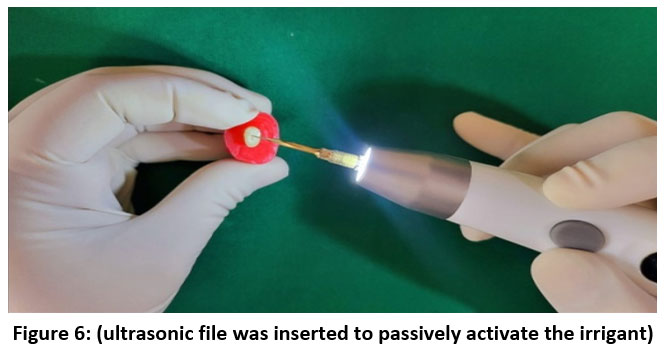 | Figure 6: (ultrasonic file was inserted to passively activate the irrigant) |
Following the irrigation procedure with contrast solution as in group I, group III underwent a one-minute period of short 2 to 3 mm push-pull strokes using a Densply F2 size gutta-percha cone, followed by an a single minute soaking in the contrast solution. Following that, the group underwent an a one-minute soaking in 3% Sodium hypochlorite, followed by another one-minute soaking, and a third cycle of short push-pull strokes using the same gutta-percha cone. A similar cycle was performed with the 2% of chlorhexidine gluconate and a concentration of 17% EDTA as irrigants.
Each and every push-pull stroke has been performed via manually at a pace of approximately 50 per minute. (figure 7)
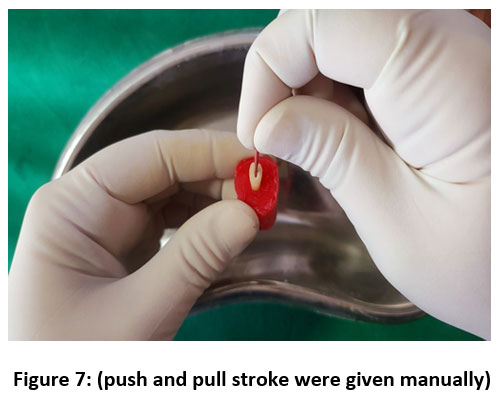 | Figure 7: (push and pull stroke were given manually) |
After final irrigation protocol, the specimens were photographed using operating microscope (PRIMA DNT) at magnification 12x and 25 cm focal length. (Figure 8 & 9)
 |
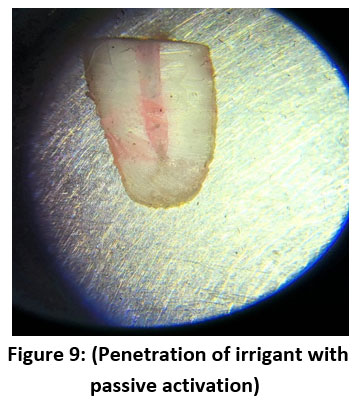 | Figure 9: (Penetration of irrigant with passive activation) |
The length between the ends of dye penetration in millimeters was used to measure the extent of dye penetration in the simulated canals at all levels. The estimation of the extent of apical penetration in the main canal was made from the point 1 mm short of the anatomic apex (corresponding with the working length) to the most apical level of dye penetration.
Result
Table 1: Comparative evaluation of irrigation penetration based on techniques
N | Mean | St. Deviation | ‘F’ statistic | Df | P value | |
Control | ||||||
Hypochlorite (1a) | 11 | 1.7891 | .03177 | 84.502 | 2 | 0.000* |
EDTA (1b) | 11 | 1.6182 | .04956 | |||
Chlorhexidine (1c) | 11 | 1.5991 | .02844 | |||
Sonic | ||||||
Hypochlorite (2a) | 11 | 2.0548 | .09826 | 10.797 | 2 | 0.000* |
EDTA (2b) | 11 | 1.9355 | .06639 | |||
Chlorhexidine (2b) | 11 | 1.9118 | .06242 | |||
Manual | ||||||
Hypochlorite (3a) | 11 | 1.9073 | .04901 | 25.627 | 2 | 0.000* |
EDTA (3b) | 11 | 1.8818 | .01722 | |||
Chlorhexidine (3c) | 11 | 1.8045 | .03142 |
*=Significant; NS = Not Significant
Table 1 shows seepage of irrigants in each of the technique employed. Independently, all the 3 groups, i.e, Control, Ultrasonic and Manual techniques showed significant difference for the irrigants used. Individually, Hypochlorite showed the highest penetration in all 3 techniques followed by EDTA and Chlorhexidine, significant at p=0.000.
Table 2: Comparative assessment of irrigant penetration in all groups with all techniques
Mean | Std. Deviation | Std. Error | |
Control – Hypochlorite | 1.7891 | .03177 | .00958 |
Control – EDTA | 1.6182 | .04956 | .01494 |
Control – Chlorhexidine | 1.5991 | .02844 | .00858 |
Ultrasonic – Hypochlorite | 2.0548 | .09826 | .02963 |
Ultrasonic – EDTA | 1.9355 | .06639 | .02002 |
Ultrasonic – Chlorhexidine | 1.9118 | .06242 | .01882 |
Manual - Hypochlorite | 1.9073 | .04901 | .01478 |
Manual - EDTA | 1.8818 | .01722 | .00519 |
Manual - Chlorhexidine | 1.8045 | .03142 | .00947 |
F statistic | 84.705 | ||
df | 8 | ||
P value | .000* |
*=Significant; NS = Not Significant
Upon a comprehensive evaluation of irrigation penetration, the Ultrasonic – Hypochlorite group (2a) exhibited the highest penetration, showing a mean value of 2.0548 ± 0.098, followed closely by ultrasonic EDTA (2c) with a mean of 1.9355 ± 0.06639. Conversely, the Control-Chlorhexidine group demonstrated the lowest penetration at 1.599 ± 0.02844. This difference in penetration levels of irrigants was found to be statistically significant with a p-value of 0.000, as detailed in Table 2.
Overall inference
Technique superiority = Ultrasonic has the highest followed by Manual and least is of control group.
Irrigant superiority = Hypochlorite was the most superior amongst the group followed by EDTA and least penetrative was Chlorhexidine.
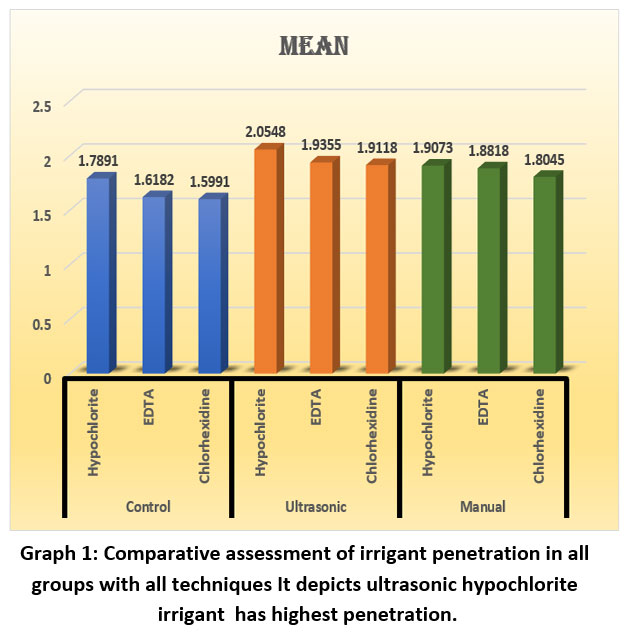 | Graph 1: Comparative assessment of irrigant penetration in all groups with all techniques It depicts ultrasonic hypochlorite irrigant has highest penetration. |
Table 3 : Pairwise distribution of techniques
Pairs | Mean difference | Std. Error | Significance |
1a versus 1b | .17091* | .02288 | .000* |
1a versus 1c | .19000* | .02288 | .000* |
1a versus 2a | -.26573* | .02288 | .000* |
1a versus 2b | -.14636* | .02288 | .000* |
1a versus 2c | -.12273* | .02288 | .000* |
1a versus 3a | -.11818* | .02288 | .000* |
1a versus 3b | -.09273* | .02288 | .003* |
1a versus 3c | -.01545 | .02288 | .999(NS) |
1b versus 1c | .01909 | .02288 | .995 (NS) |
1b versus 2a | -.43664* | .02288 | .000* |
1b versus 2b | -.31727* | .02288 | .000* |
1b versus 2c | -.29364* | .02288 | .000* |
1b versus 3a | -.28909* | .02288 | .000* |
1b versus 3b | -.26364* | .02288 | .000* |
1b versus 3c | -.18636* | .02288 | .000* |
1c versus 2a | -.45573* | .02288 | .000* |
1c versus 2b | -.33636* | .02288 | .000* |
1c versus 2c | -.31273* | .02288 | .000* |
1c versus 3a | -.30818* | .02288 | .000* |
1c versus 3b | -.28273* | .02288 | .000* |
1c versus 3c | -.20545* | .02288 | .000* |
2a versus 2b | .11936* | .02288 | .000* |
2a versus 2c | .14300* | .02288 | .000* |
2a versus 3a | .14755* | .02288 | .000* |
2a versus 3b | .17300* | .02288 | .000** |
2a versus 3c | .25027* | .02288 | .000 |
2b versus 2c | .02364 | .02288 | .982 (NS) |
2b versus 3a | .02818 | .02288 | .947 (NS) |
2b versus 3b | .05364 | .02288 | .328 (NS) |
2b versus 3c | .13091* | .02288 | .000* |
2c versus 3a | .00455 | .02288 | 1.000(NS) |
2c versus 3b | .03000 | .02288 | .926(NS) |
2c versus 3c | .10727* | .02288 | .000* |
3a versus 3b | .02545 | .02288 | .971(NS) |
3a versus 3c | .10273* | .02288 | .001* |
3b versus 3c | .07727* | .02288 | .029* |
*=Significant; NS = Not Significant
The greatest mean difference in penetration of irrigation was noted between Ultrasonic technique with Hypochlorite irrigant (2a) versus control technique with Chlorhexidine (1c).
Data Analysis
The Statistical Package for the social sciences (SPSS Version 23; Chicago Inc., IL, USA) was used to analyse the collected data. To assess the statistical significance of the comparisons, specific statistical tests were used to analyse the data.
To ascertain whether the data was typical for assessing the conclusion between the irrigants penetrating capacity, the Kolmogorov-Smirnov test was applied. The test revealed no discernible change, validating the typical distribution of the data collected.
Standard deviation and mean values were utilized to compare the variables. Using one way ANOVA, the mean of the various irrigation penetration measurements by technique between the groups were evaluated. To detect significant variations between each pair, Tukeys post-hoc test was carried out. P value lesser than 0.05 was considered to be statistically significant.
Discussion
Irrigation is crucial to a successful root canal procedure. Depending on the irrigant used, it can carry out a range of vital functions, including reducing friction between the instrument and dentine, boosting the effectiveness of the files cutting, dissolving tissue, cooling the file and tooth, and having washing and antimicrobial effects.
The results of this investigation showed that there were significant disparities among the groups regarding to irrigant penetration into the root canals apical third. To ensure the efficacy of endodontic therapy, mechanical instrumentation is combined with the use of irrigation, disinfectants, rinses, and between-visit drugs.
In endodontic treatments, sodium hypochlorite (NaOCl), a halogenated material, is usually used to irrigate the root canal. NaOCl has been known for years for its capacity to dissolve and perform as a protease as well as for its debridement properties. Because the irrigation agent was activated with enough force to overcome the apical vapour lock, ultrasonic activation of the irrigant also resulted in maximal lateral canal penetration. Additionally, the file oscillation may trigger cavitation and acoustic streaming effects. Furthermore, because ultrasonic increases the wetness of pulp tissue remains after agitation, they have a synergistic effect on NaOCl “tissue-dissolving capabilities.
The manual dynamic agitation technique may assist prevent apical gas entrapment at 0 to 2 mm of the apical seat by repeatedly injecting the gutta-percha. The MDA groups irrigants apical access, however, was not as good as the PUI groups. This could be the result of currents being formed at a lower frequency due to the push-pull action of the gutta-percha point at 50 strokes per minute, whereas currents during PUI are generated at a higher frequency of 40 to 45 kHz due to secondary acoustic streaming.
This permitted the vapour lock to break with greater efficacy, enhancing the amount of apical irrigant flow in the passive ultrasonic group of 3% sodium hypochlorite.
Conclusion
The most efficient technique for delivering irrigants up to the working length is passive ultrasonic irrigation, which is followed by manual irrigation.
Acknowledgement
This endeavor would not have been possible without the guidance of my Professor and the Head of The Department. I am also thankful to my classmates and cohort members, for their editing help, late-night feedback sessions, and moral support.
Funding Sources
The author(s) received no financial support for the research, authorship and publication of this article
Conflict of Interest
There is no conflict of interest
Data Availability Statement
The manuscript incorporates all the data sets examined through this research study.
Ethics Statement
This research did not involve human participants, animal subjects, or any material that requires ethical approval.
Informed Consent Statement
Not applicable in this section of the declarations
Authors' Contribution
Sajal Chaudhary – I confirm sole responsibility for the following: study conception and design, data collection, analysis and interpretation of results, and manuscript preparation.
Pankaj Mishra - Sir helped me in conceptualization, idea formulation and evolution of research goals and aims.
Santosh Kumar Singh – Sir provided support in project administration, Management and coordination responsibility for the research activity planning and execution.
Muskan Sitlani – Ma’am helped me in data Curation, Management of activities to annotate, Scrub data and maintain research data for initial use and later reuse.
Savarna Goswami – My colleague helped me in preparation, creation and/or presentation of the published work and specifically visualization.
Avneel Neema – My Co-PG supported me in application of statistical, computational, or other formal techniques to analyse or synthesize study data.
References
- Castelo-Baz P, Varela-Patiño P, Cantatore G, et al. In vitro comparison of passive and continuous ultrasonic irrigation in curved root canals. J Clin Exp Dent. 2016;8(4):e437-e441. Published 2016 Oct 1. doi:10.4317/jced.53023
- Haapasalo M, Shen Y, Wang Z, Gao Y. Irrigation in endodontics. Br Dent J. 2014;216(6):299-303. doi:10.1038/sj.bdj.2014.204s
- Suprabha B. Effectiveness of Ultrasonic and Manual Dynamic Agitation Techniques in Irrigant Penetration: An in vitro Study. World Journal of Dentistry. 2017;8(3):207-212. doi:https://doi.org/10.5005/jp-journals-10015-1439
- Machtou PP. Manual dynamic activation technique. Clinical Dentistry Reviewed. 2018;2(1). doi:https://doi.org/10.1007/s41894-018-0034-4
- Chellapandian DK, Kondas DV venkatesh, Ravichandran DA, Lecturer D sujana praveen S. Recent Advancements In Endodontic Irrigation Systems. Journal of Positive School Psychology. Published online April 28, 2022:3809-3822. Accessed March 26, 2024 https://journalppw.com/index.php/jpsp/article/view/3983
- Cameron JA. The synergistic relationship between ultrasound and sodium hypochlorite: a scanning electron microscope evaluation. J Endod. 1987;13(11):541-545. doi:10.1016/S0099-2399(87)80034-1
- Boutsioukis C, Lambrianidis T, Verhaagen B, et al. The effect of needle-insertion depth on the irrigant flow in the root canal: evaluation using an unsteady computational fluid dynamics model. J Endod. 2010;36(10):1664-1668. doi:10.1016/j.joen.2010.06.023
- Haapasalo M, Shen Y, Wang Z, Gao Y. Irrigation in endodontics. Br Dent J. 2014;216(6):299-303. doi:10.1038/sj.bdj.2014.204
- Kandaswamy D, Venkateshbabu N. Root canal irrigants. J Conserv Dent. 2010;13(4):256-264. doi:10.4103/0972-0707.73378
- Mohammadi Z. Sodium hypochlorite in endodontics: an update review. International Dental Journal. 2008;58(6):329-341. doi:https://doi.org/10.1111/j.1875-595x.2008.tb00354.x