.jpg)

Photobiomodulation is a Physical and Chemical Event and its Cellular Mechanisms of Action in Pain: Objective Systematic Review.
Vitor Hugo Panhóca1,2*  , Gabriela Dias Rosso dos Santos2 , Simone Aparecida Ferreira3 , Viviane Brocca de Souza3 and Antônio Sérgio Guimarães2
1Biophotonics Laboratory of Institute of Physics of São Carlos, University of São Paulo (USP), São Paulo, Brazil .
2Department of Orofacial Pain, Faculdade Sao Leopoldo Mandic, São Paulo, Brazil .
3Dentistry Scholl, Central Paulista University Center — UNICEP, São Carlos, Brazil .
http://dx.doi.org/10.12944/EDJ.06.0102.04
This literature review presents the action of photobiomodulation (PBM) in the production of transmembrane proteins by neuronal cells to control transient pain, preventing this initial pain from becoming chronic. The literature collected can prove that this protein production pathway may be viable for anti-pain effects in humans. The search was conducted in four databases: PubMed, Google Scholar, and Web of Science. The keywords “photobiomodulation proteins” and “photobiomodulation pain” supplied the selection of papers issued in the last 2 years and the most cited papers on Google Scholar written in English. 10 recent and relevant articles were selected, of the papers found. All articles showed that PBM has a positive effect on pain, with one of them showing its effect on modulating protein production in cells. Articles have showed that PBM has a favourable effect on controlling transient peripheral pain. PBM has advantageous effects on transient peripheral pain. However, more experiments are necessary to clearly conclude this line of research, which can also be effective in chronic pain when applied to the correct areas in the brain.
Copy the following to cite this article:
Panhóca V. H, Santos G. D. R. D, Ferreira S. A, Souza V. B. D, Guimarães A. S. Photobiomodulation is a Physical and Chemical Event and its Cellular Mechanisms of Action in Pain: Objective Systematic Review. Enviro Dental Journal 2024; 6(1,2).
DOI:http://dx.doi.org/10.12944/EDJ.06.0102.04Copy the following to cite this URL:
Panhóca V. H, Santos G. D. R. D, Ferreira S. A, Souza V. B. D, Guimarães A. S. Photobiomodulation is a Physical and Chemical Event and its Cellular Mechanisms of Action in Pain: Objective Systematic Review. Enviro Dental Journal 2024; 6(1,2). Available here: https://bit.ly/3Xzn8rM
Download article (pdf) Citation Manager

Introduction
Photobiomodulation (PBM), also known as low power laser, does not generate tissue heating capable of causing thermal damage to the treated tissues. Biophotonics applied in healthcare uses wavelengths of light with energy density ranging from 1 to 150 J/cm2 and wavelengths between 600 and 1070 nm.1,2 New wavelengths have been shown in clinical experiments with an anti- pain effect using violet light emitting diodes (LEDs) with a wavelength of approximately 410 nm and surface contact irradiance of 165 mW/cm² in tooth whitening in patients with dentine sensitivity.3 Cellular metabolism is mediated by molecular changes that activate and deactivate a particular cellular response and/or function, and this is accomplished through several ways, including desensitization of receptors to their ligands, release of signalling proteins, restoration of normal ligand concentrations, which can be modulated through photobiomodulation.4
The presence of competitors and specific activators of extracellular signalling and transmembrane proteins influence cellular metabolism.5 Some pioneering research was designed to investigate alternations of epigenetic factors influencing pain control after PBM application.6 In this study, PBM in the two experimentally designed protocols-controlled pain (allodynia and hyperalgesia) after 21 days. It has been observed that some molecules such as transforming growth factor beta (TGF-?) and anti-glutamic acid decarboxylase 65 (Gad65) increased after PBM and it was found that the expression of neuro-restrictive silencer factor (NRSF), histone deacetylase 1 (HDAC1) and methyltransferase 3 alpha (DNMT3a) were not reduced after the two protocols studied. 6
Photobiomodulation has long been used for tissue regeneration, pain and inflammation; however, the cellular explanation has always been related to the increased production of adenosine triphosphate (ATP), nitrous oxide and hydroxyl radical (OH). Protein synthesis and its effects were studied, corroborating what we found clinically in the reduction of peripheral pain through photobiomodulation.2,7 The main objective of this study is to show recent scientific evidence about the potential anti-pain action of PBM in health-promoting science.
Methodology
Experimental Study Design
In this brief literature review of papers publishing the application of PBM in transient pain and its mechanisms. In the methodological evaluation, we looked for recent articles most cited in the last 5 years and the most cited in the last 20 years. It was conducted on more comprehensive research platforms such as Google scholar and more careful platforms for impactful publications with scientific evidence such as PubMed and Web of Science. The search was conducted in four databases: PubMed, Google Scholar, and Web of Science. The keywords “photobiomodulation proteins” and “photobiomodulation pain” presented a collection of papers issued in the last 2 years and the most cited papers on Google Scholar written in English. The inclusion criteria for articles were in accordance with the content of the abstract. The exclusion criteria were duplicate articles in the same databases and articles in which the abstract had different titles and content. 10 relevant and recent articles were selected from the papers found (see Fig. 1).
Search Strategy and Information Sources
The bibliographic survey was conducted in April 2024 following three electronic data bases: PubMed, Web of Science and Google scholar (see Table 1).
 | Figure 1: Diagram containing the article selection flow. Text exclusion selection according to Google Scholar platform criteria and publication date. |
Table 1: Bibliographic survey strategy on the different data platforms used.
PubMed | “photobiomodulation pain” and” |
Web of science | “photobiomodulation pain” and” |
Google scholar | “photobiomodulation pain” and” |
Results
The results obtained in this brief literature review corroborate our hypothesis of increased proteins production through photobiomodulation, such as transmembrane proteins that can influence the neuronal sodium and potassium pump, repolarizing its neural membrane and modulating pain. This can be seen since ten papers prove this anti-pain effect and eight of these papers cite the effects on the production of proteins through various intracellular routes. The most relevant findings were organized in the table below. (see Table 2).
Table 2: Papers about direct at point revision
Paper | “photobiomodulation pain” | “photobiomodulation proteins” |
Salehpour et al. 2018¹ | *Clinical studies have shown that LEDs irradiation (660 and 850 nm) on the back and thighs alleviated the symptoms of depression in patients complaining of low back pain. * The application of PBM can benefit muscular performance and reduce fatigue and muscle pain, in addition to helping with weight loss in combination with physical exercise. | *Light absorption through ion channels results in the release of calcium (Ca2+) and leads to the activation of transcription factors and gene expression. *Because neural tissues contain substantial amounts of mitochondrial cytochrome c oxidase (CCO), application of red to near-infrared (NIR) light with wavelengths 600–850 nm for brain PBM therapy is highly attractive. |
Finfter et al.20248 | *PBM applied with a high-power laser far from the tissue can have an anti-pain, non-pharmacological effect, without thermal damage to the patient presenting pain in oral mucositis (OM). *However, a small sample size may be related to pain reduction in this article. | *PBM may down regulate substance P in dorsal horn neurons that initiate central sensitization and the onset of neuropathic pain. |
Hamblin,20187 | *PBM is becoming a very effective therapy that can be used to reduce the side effects of cancer therapy (radiotherapy and/or chemotherapy). One of the most debilitating adverse effects for patients with OM is pain in the oral mucosa, which makes it difficult for the patient to eat normally, lose weight and reduce the immune response. | *The main molecule presents in the cell membrane, Cytochrome c oxidase, which transfers energy in the mitochondrial respiratory chain as the primary chromophore, signals and explains how a single brief exposure to the effects of light on the body can last for hours, days or even weeks in PBM. This event is physical and chemical at the same time. |
Hennessy and Hamblin, 20179 | *In the 50 years since then, low level light therapy (LLLT), or PBM, has come into use for the treatment of pain. *PBM can be applied to target a specific area in the body or different from the brain, as in low back pain, the brain can have its pain modulation and remotely benefit pain felt distant or referred from a distance. | *PBM possesses the ability to modulate levels of cytokines and proteins that function as important signalling molecules for the immune system. *Denser branches and increased inter connectivity between fibers were observed in neural tissue of embryonic rats following irradiation with 780nm light, indicating increased action of these proteins. |
Dompe et al. 202010 | *PBM is a minimally invasive therapy with anti-pain and anti-inflammatory effects, also having healing and tissue repair effects. | *Reactive Oxygen Species (ROS) participate in normal cellular metabolism and in the production of ATP synthesis, which participate in the cascade of protein production that act through redox reactions and are involved in tissue proliferation. |
Navarro- Ledesma et al.202411 | *This study presents PBM for treatment for 4 weeks with significant results in pain reduction and a better quality of life in individuals suffering from Fibromyalgia (FM). | *PBM applied to the human body, presents a low risk to the patient's health and solid results in strategy improvement in human health with molecular responses through mitochondrial pathway and its specific mechanisms. Being considered a powerful tool for promote mitochondrial health. |
González- Muñoz et al.202312 | *PBM has propitious effects on chronic pain and inflammation. However, more experiments need to be completed in this line of knowledge to make this mechanism clear. | |
Behroozi et al.20246 | *In this pioneering study for clarify the role of some epigenetic markers NRSF, HDAC1 and DNMT3a in PBM applied to treat neuropathic pain (NP). In both treatment protocols performed, he presented reduced pain (allodynia and hyperalgesia) after 3 weeks of treatment. | * PBM in both treatments in presented protocols, reduced pain (allodynia and hyperalgesia) after 3 weeks. Although some molecules, such as TGF-? and Gad65 increased after PBM application, we found stable expression of NRSF, HDAC1e and DNMT3a after the two protocols performed for the treatment of neuropathic pain (NP). |
Furquim et al.202313 | *Women with chronic pain related to temporomandibular dysfunction (TMD), the application of PBM at specific points it is more effective than the application in pre- established points. PBM with customized protocols for each clinical case must be carried out, based on palpation and correct diagnosis. | |
Cheng et al. 202114 | *Biophotonics can be another useful therapy for anti-allergy application, as it is a safe and environmentally efficient treatment option or alternative to reduce physical and psychological pain and social problems that promote discomfort such as acute and chronic pain in various pathologies. | *Photoreceptors are photopigments in the cell membrane, like opsins, which are G protein-coupled receptors that absorb photons. PBM promote intracellular messenger cyclic guanidine monophosphate (cGMP) concentration decreases due to the activation of the enzyme cGMP-phosphodiesterase. This promotes the closure of sodium (Na+) channels controlled by nucleotides, resulting in hyperpolarization of the photoreceptor cell and phototransduction, controlling pain. |
Illustrative diagram of the mechanism of action of PBM on pain (see Fig.2)
Discussion
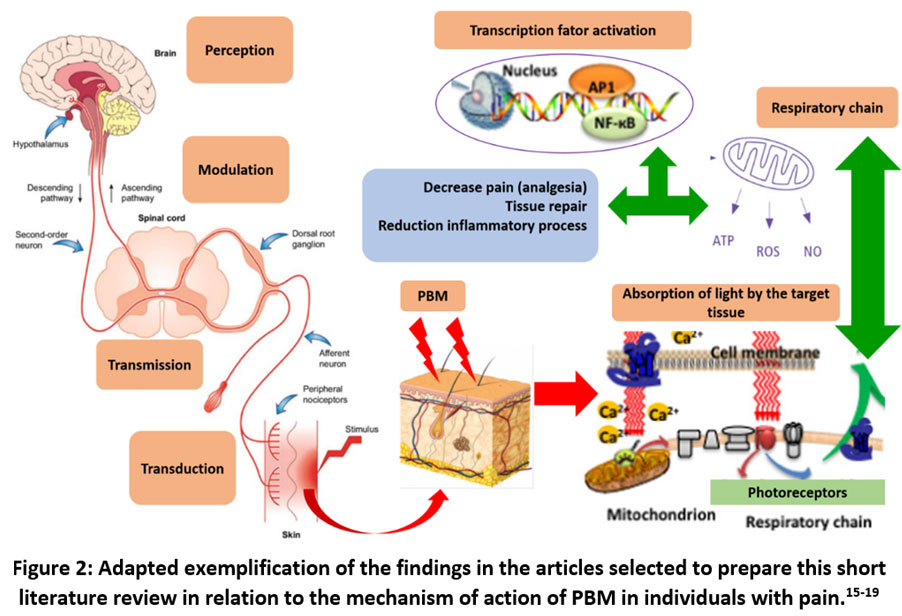 | Figure 2: Adapted exemplification of the findings in the articles selected to prepare this short literature review in relation to the mechanism of action of PBM in individuals with pain.15-19 |
Diagram abbreviations: Sodium channels (Ca+2); adenosine triphosphate (ATP); reactive Oxygen Species (ROS); nitric oxide (NO); nuclear factor kappa B (NF-?B) and activator protein-1(AP-1).
Mechanisms of Phobiomodulation to Analgesia
The PBM has a characteristic represented by a Gaussian graph that is becoming obsolete, which is the biphasic dose response (known as the Arndt-Schulz law)20, according to which a high dose causes a decrease in the physiological function of the cell, while a low dose causes excitation of the same cellular function. In fact, it is known that after a certain dose what occurs is thermal damage to the tissue, and not inhibition of the physiological process of protein production and other clinical effects. It is believed that an extremely low dose of light has no effect, an ideal dose would have a positive effect until it reaches a plateau. If the light dose is increased too much in relation to the ideal, the benefit ceases due to the saturation of photon absorption, reaching a limit. Further increases will begin to have detrimental effects on tissues that we consider thermal tissue damage. Optimal doses can induce the expression within cells of several protective factors, such as antioxidant enzymes and antiapoptotic proteins, that will improve normal function and protect against subsequent lethal challenges.7,16,20 Transient receptor potential (TRP) channel proteins persist throughout of evolution and are widely found in the cells of various organisms. The ion channels that allow the passage of molecules are sensitive to PBM and related to the opsin chromophore (isomerization of a cis-retinal molecule to the trans configuration), as found in Drosophila photoreceptors.7
In a recent study carried out by Behroozi et al.20246 evaluating the expression of DNMT3a and HDAC1 proteins using the western blot method. It has been proven that 3 weeks after PBM, HDAC1 expression increases compared to the control group (p < 0.05). This clarifies the role of some epigenetic markers in PBM and their potential to reduce pain (allodynia and hyperalgesia) after 3 weeks. Although some molecules, such as TGF-? and Gad65, increased after the application of FBM, we found stable expression of NRSF, HDAC1e and DNMT3a after the two protocols performed for the treatment of neuropathic pain (NP).6
Clinical Therapeutic Applications Phobiomodulation Pain
Laboratory and clinical experiments that corroborate the mechanisms of pain modulation through the application of PBM. Acute or transient pain manifests for approximately 3 months in normal humans and may evolve into chronic or persistent pain after this period.21,22
This difference in somatosensory sensitivity alters all central neural plasticity in pain perception. Peripheral mechanisms and central mechanisms of pain sensitization can be easily understood by interpreting phantom pain in cases of amputations where, despite the individual no longer having a limb, they feel pain in the limb that was removed, hence the need for PBM treatment to be applied with ideal dosimetry and in the appropriate location. Studies prove the effectiveness of pain control with PBM in treating a variety of acute and chronic pain conditions, such as: orofacial pain, fibromyalgia, trigeminal neuralgia, neck pain and low back pain.14, 21-26
Several other pathologies in clinical practice have shown the need to adapt new experimental designs for pain considering basic knowledge about cellular response mechanisms during the application of PBM.20
The advantage of PBM is its local applicability without pharmacological medication or associated with this therapy. PBM has the characteristic of being minimally invasive, which attracts patients and healthcare professionals to this therapy. The adverse effects of PBM are almost non-existent in clinical studies applied to both animals and humans. Therefore, studies with adequate dosimetry for each anatomical part involved in the pathology and the consideration of cellular and psychosomatic effects must be considered for a treatment protocol in subsequent studies.20-25
The limitations of this study are related to the small number of platforms used to collect papers related to this objective review, which can be increased in a systematic review with a larger scope of articles. The clinical articles cited in this systematic review can be better proven in relation to our hypothesis of laser action on neural tissues if they are carried out longitudinally and with a larger number of volunteers, as in the OPPERA project (Orofacial Pain: Prospective Evaluation and Risk Assessment)27. Our self-reported citations correspond to the clinical experience of our research team and can be proven by new laboratory experiments in animals and other research groups, some of which have already been reported in the literature.
New research may better address the effects of PBM on central sensitization that occurs in patients with chronic and neuropathic pain, especially with regard to the reduction in the reuptake of substance P and glutamate. Studies should consider the biopsychosocial aspect of pain management linked to the use of PBM.
Conclusion
Given this brief and objective review evaluating articles accepted, reviewed and published in impact journals and with robust scientific evidence. We can conclude that therapy applying PBM when applied adequate or ideal dosimetry to neural tissue can be an effective therapeutic modality in the treatment of pain. Treatment must be based on solid knowledge of peripherally and centrally modulated pain. It is also evident that the cellular mechanism for producing molecules involved in modulating pain with activation of photoreceptors must be considered according to the physical characteristics of the applied laser. Psychological, economic and social factors also influence the clinical presentation of pain. Studies should consider the biopsychosocial aspect of pain management linked to the use of PBM.
Acknowledgement
This study was supported by Embrapii through a scholarship offered to one of the authors, Vitor Hugo Panhóca. The authors also gratefully acknowledge the scientific contributions and helpful advice of Marcela Sene-Fiorese and Fernanda Rossi Paolillo.
Funding Sources
The author(s) received no financial support for the research, authorship, and/or publication of this article.
Conflict of Interest
The authors do not have any conflict of interest
Data Availability Statement
This statement does not apply to this article
Ethics Statement
This research did not involve human participants, animal subjects, or any material that requires ethical approval
Informed Consent Statement
This study did not involve human participants, and therefore, informed consent was not required
Authors’ Contributions
Vitor Hugo Panhóca, Simone Aparecida Ferreira, Gabriela Dias Rosso dos Santos, Viviane Brocca de Souza were involved in the initial draft and original writing. Antônio Sérgio Guimarães and Gabriela Dias Rosso dos Santos collaborated in the final review of this article.
References
- Salehpour F, Mahmoudi J, Kamari F, Sadigh-Eteghad S, Rasta SH, Hamblin MR. Brain Photobiomodulation Therapy: a Narrative Review. Mol Neurobiol [Internet]. 11 jan 2018 [citado 29 jul 2024];55(8):6601-36. Available from: https://doi.org/10.1007/s12035-017-0852-4
CrossRef - Karu TI, Pyatibrat LV, Kolyakov SF, Afanasyeva NI. Absorption measurements of a cell monolayer relevant to phototherapy: Reduction of cytochrome c oxidase under near IR radiation. J Photochem Photobiol B [Internet]. Nov 2005 [citado 29 jul 2024];81(2):98-106. Available from: https://doi.org/10.1016/j.jphotobiol.2005.07.002
CrossRef - Panhóca VH, Nogueira MS, Zanin FAA, Brugnera AP, Jr AB, V, et al. Dental Sensitivity and Color Change in Patients Undergoing Dental Bleaching with Application of Violet Light. Oral Health and Dental Management [Internet]. 2022 Jun 17;21(6):1–14. Available from: https://www.walshmedicalmedia.com/open-access/dental-sensitivity-and-color-change-in-patients-undergoing-dental-bleaching-with-application-of-violet-light-112124.html
- Tabibzadeh A, Tameshkel FS, Moradi Y, Soltani S, Moradi-Lakeh M, Ashrafi GH, et al. Signal transduction pathway mutations in gastrointestinal (GI) cancers: a systematic review and meta-analysis. Scientific Reports [Internet]. 2020 Oct 30;10(1):18713. Available from: https://www.nature.com/articles/s41598-020-73770-1
CrossRef - Jere SW, Abrahamse H, Houreld NN. Interaction of the AKT and ?-catenin signalling pathways and the influence of photobiomodulation on cellular signalling proteins in diabetic wound healing. J Biomed Sci [Internet]. 21 set 2023 [citado 29 jul 2024];30(1). Available from: https://doi.org/10.1186/s12929-023-00974-8
CrossRef - Behroozi Z, Kookli K, Ghadaksaz A, Motavaf M, Fazeli SM, Nezhad AM, Ramezani F, Janzadeh A. Evaluation of epigenetic (HDAC, DNMT) and pain (Gad65, TGF) factors following photobiomodulation therapy in a neuropathic pain model. Photochem Photobiol [Internet]. 18 jun 2023 [citado 29 jul 2024]. Available from: https://doi.org/10.1111/php.13824
CrossRef - Hamblin MR. Mechanisms and Mitochondrial Redox Signaling in Photobiomodulation. Photochem Photobiol [Internet]. 19 jan 2018 [citado 29 jul 2024];94(2):199-212. Available from: https://doi.org/10.1111/php.128648- Hennessy M, Hamblin MR. Photobiomodulation and the brain: a new paradigm. J Opt. 2017; 19(1):013003.
CrossRef - Finfter O, Cohen R, Hanut A, Gavish L, Zadik Y. High?power laser photobiomodulation therapy for immediate pain relief of refractory oral mucositis. Oral Dis [Internet]. 19 maio 2023 [citado 29 jul 2024]. Available from: https://doi.org/10.1111/odi.14618
CrossRef - Hennessy M, Hamblin MR. Photobiomodulation and the brain: a new paradigm. J Opt [Internet]. 14 dez 2016 [citado 29 jul 2024];19(1):013003. Available from: https://doi.org/10.1088/2040-8986/19/1/013003
CrossRef - Dompe C, Moncrieff L, Matys J, Grzech-Le?niak K, Kocherova I, Bryja A, Bruska M, Dominiak M, Mozdziak P, Skiba THI, Shibli JA, Angelova Volponi A, Kempisty B, Dyszkiewicz-Konwi?ska M. Photobiomodulation-Underlying Mechanism and Clinical Applications. J Clin Med. 2020 Jun 3;9(6):1724. doi: 10.3390/jcm9061724. PMID: 32503238; PMCID: PMC7356229.
CrossRef - Navarro-Ledesma S, Carroll JD, González-Muñoz A, Burton P. Outcomes of whole-body photobiomodulation on pain, quality of life, leisure physical activity, pain catastrophizing, kinesiophobia, and self-efficacy: a prospective randomized triple-blinded clinical trial with 6 months of follow-up. Front Neurosci [Internet]. 31 jan 2024 [citado 29 jul 2024];18. Available from: https://doi.org/10.3389/fnins.2024.1264821
CrossRef - González-Muñoz A, Cuevas-Cervera M, Pérez-Montilla JJ, Aguilar-Núñez D, Hamed-Hamed D, Aguilar-García M, Pruimboom L, Navarro-Ledesma S. Efficacy of Photobiomodulation Therapy in the Treatment of Pain and Inflammation: A Literature Review. Healthcare [Internet]. 24 mar 2023 [citado 29 jul 2024];11(7):938. Available from: https://doi.org/10.3390/healthcare11070938
CrossRef - Furquim LR, Mélo AM, Barbosa AF, Olivato OP, Silva-Sousa YT, Leite-Panissi CR, Magri LV. Application of photobiomodulation for chronic pain-related TMD on pain points versus pre-established points: Randomized clinical trial. J Photochem Photobiol B [Internet]. Jan 2023 [citado 29 jul 2024]; 238:112612. Available from: https://doi.org/10.1016/j.jphotobiol.2022.112612
CrossRef - Cheng K, Martin LF, Slepian MJ, Patwardhan AM, Ibrahim MM. Mechanisms and Pathways of Pain Photobiomodulation: A Narrative Review. J Pain [Internet]. Jul 2021 [citado 29 jul 2024];22(7):763-77. Available from: https://doi.org/10.1016/j.jpain.2021.02.00514
CrossRef - Martinez-Vazquez P, Jensen EW. Different perspectives for monitoring nociception during general anesthesia. Korean J Anesthesiol [Internet]. 1 abr 2022 [citado 29 jul 2024];75(2):112-23. Available from: https://doi.org/10.4097/kja.22002
CrossRef - Chung H, Dai T, Sharma SK, Huang YY, Carroll JD, Hamblin MR. The Nuts and Bolts of Low-level Laser (Light) Therapy. Ann Biomed Eng [Internet]. 2 nov 2011 [citado 29 jul 2024];40(2):516-33. Available from: https://doi.org/10.1007/s10439-011-0454-7
CrossRef - Mussttaf RA, Jenkins DF, Jha AN. Assessing the impact of low level laser therapy (LLLT) on biological systems: a review. Int J Radiat Biol [Internet]. 7 jan 2019 [citado 29 jul 2024];95(2):120-43. Available from: https://doi.org/10.1080/09553002.2019.1524944
CrossRef - Sommer AP, Pinheiro AL, Mester AR, Franke RP, Whelan HT. Biostimulatory Windows in Low-Intensity Laser Activation: Lasers, Scanners, and NASA's Light-Emitting Diode Array System. J Clin Laser Med Amp Surg [Internet]. Fev 2001 [citado 29 jul 2024];19(1):29-33. Available from: https://doi.org/10.1089/104454701750066910
CrossRef - Afridi B, Khan H, Akkol EK. Pain Perception and Management: Where Are We Standing. Curr Mol Pharmacol [Internet]. 11 jun 2020 [citado 29 jul 2024];13. Available from: https://doi.org/10.2174/1874467213666200611142438
CrossRef - Agrawal T, Gupta GK, Rai V, Carroll JD, Hamblin MR. Pre-Conditioning with Low-Level Laser (Light) Therapy: Light before the Storm. Dose Response [Internet]. 22 set 2014 [citado 29 jul 2024];12(4): dose—response.1. Available from: https://doi.org/10.2203/dose-response.14-032.agrawal
CrossRef - Panhóca VH, Bagnato VS, Alves N, Paolillo FR, Deana NF. Increased Oral Health-Related Quality of Life Postsynergistic Treatment with Ultrasound and Photobiomodulation Therapy in Patients with Temporomandibular Disorders. Photobiomodul Photomed Laser Surg [Internet]. 1 nov 2019 [citado 29 jul 2024];37(11):694-9. Available from: https://doi.org/10.1089/photob.2019.4697
CrossRef - Panhóca VH, Lopes L, Paolillo F, Bagnato VS. Treatment of Temporomandibular Disorder Using Synergistic Laser and Ultrasound Application [Internet]. [cited 2024 Jul 29]. Available from: https://www.walshmedicalmedia.com/open-access/treatment-of-temporomandibular-disorder-using-synergistic-laser-andultrasound-application.pdf
- Nogueira MS, Gianini CA, Pereira RB., Silvani G, Bagnato VS, Panhóca VH. Photobiomodulation therapy for the management of oral mucositis: a clinical case. In Imaging, Therapeutics, and Advanced Technology in Head and Neck Surgery and Otolaryngology 2024 (Vol. 12818, pp. 19-22). SPIE.]. Available from: https://doi.org/10.1117/12.3003713
CrossRef - Ren H, Liu J, Liu Y, Yu C, Bao G, Kang H. Comparative effectiveness of low?level laser therapy with different wavelengths and transcutaneous electric nerve stimulation in the treatment of pain caused by temporomandibular disorders: A systematic review and network meta?analysis. J Oral Rehabil [Internet]. 21 ago 2021. Available from: https://doi.org/10.1111/joor.13230.
CrossRef - Fourré A, Monnier F, Ris L, Telliez F, Michielsen J, Roussel N, Hage R. Low-back related leg pain: is the nerve guilty? How to differentiate the underlying pain mechanism. J Man Amp Manip Ther [Internet]. 23 jun 2022 [citado 29 jul 2024]:1-7. Available from: https://doi.org/10.1080/10669817.2022.2092266
CrossRef - Petroianu GA, Aloum L, Adem A. Neuropathic pain: Mechanisms and therapeutic strategies. Front Cell Dev Biol. 2023,11:1072629. Available from: https://pubmed.ncbi.nlm.nih.gov/36727110/
CrossRef - Slade GD, Ohrbach R, Greenspan JD, Fillingim RB, Bair E, Sanders AE, et al. Painful Temporomandibular Disorder: Decade of Discovery from OPPERA Studies. Journal of Dental Research. 2016 Jul 21;95(10):1084–92. Available from: https://www.ncbi.nlm.nih.gov/pmc/articles/PMC5004239/
CrossRef