.jpg)

Metabolomics in Periodontal Disease - A Mini Review
Dr. Arif Siddiqui1*  , Deepa D1 , Shalabh Mehrotra1 and Anjali Sharma2
1Department of Periodontology and Implantology, Teerthanker Mahaveer Dental College and Research Centre, Moradabad, Uttar Pradesh, India .
2Department of Conservative Dentistry and Endodontics, Teerthanker Mahaveer Dental College and Research Centre, Moradabad, Uttar Pradesh, India .
http://dx.doi.org/10.12944/EDJ.04.01.04
Periodontitis is the most common oral disease. It is a chronic disease that is characterised by the destruction of the tissues. It is caused by multifactorial aetiology. Variation in host metabolism and microbes results in the development of periodontitis. Saliva provides us with a protective role of lubrication, neutralizing the pH, mineralising the bones and fighting microbes in a diseased oral cavity. We need to identify metabolites in saliva to know the aetiology and stage of periodontitis. Some metabolites may help in the diagnosis and treatment of periodontitis. Various classes of the biochemicals like amino acids, lipids, carbohydrates, nuclear peptides, dipeptides are changed in periodontitis. Most importantly, there is an increase in the levels of protease, glycosidase and lipase activity in chronic periodontal disease that forms the most favourable time for the growth of bacteria. There is a deficiency in contempered screening methods. Therefore, we should understand the arising need for metabolites for better diagnosis and treatment of periodontitis.
Bacteria; Biomarker; Inflammation; Metabolomic; Periodontitis
Copy the following to cite this article:
Siddiqui A, Deepa D, Mehrotra S, Sharma A. Metabolomics in Periodontal Disease - A Mini-Review. Enviro Dental Journal 2021; 4(1). DOI:http://dx.doi.org/10.12944/EDJ.04.01.04
Copy the following to cite this URL:
Siddiqui A, Deepa D, Mehrotra S, Sharma A. Metabolomics in Periodontal Disease - A Mini-Review. Enviro Dental Journal 2021; 4(1). Available From: https://bit.ly/3IKBKLL
Download article (pdf) Citation Manager


Introduction
Inflammation of the periodontium is known as periodontitis. Its occurs due to the host response and the individual immune reaction.1 In gingivitis the inflammation is limited to gingiva leading to bleeding and swelling, however in periodontitis it involves the deeper structures. Rate of occurrence of both the conditions is higher in diabetic individuals.1 Its occurrence is related to time duration of diabetes and glycemic control. Diabetic patients have a high prevalence of gingivitis, periodontitis, oral candidiasis, and xerostomia, and the severity of these diseases are correlated with the duration of diabetes and degree of glycemic control.2,3 Microbial diversities is influenced by the amount of glucose in saliva.4
Microbial ecology could be understood by metagenomic studies.4 Therefore, a holistic approach is provided to the individual with patient centered medicine. In past, Nuclear magnetic resonance (NMR)based metabolomics has been used successfully for oral conditions such as dental caries, oral cancer, sjogren syndrome, periodontal disease as well as for some systemic conditions like neurodegenerative disorders, dementia and cardiovascular diseases. The aim of this article is to understand the importance of metabolomics in periodontitis.
Metabolomics
‘Omics’ represents a strong tool which tells about the steps taking place during bone formation and also in osteointegration.4 It is also used to identify signaling molecules as well as signaling pathways. Earlier words like transcriptomics, metagenomics, and proteomics were used frequently but now these have been replaced by the term metabolomics. It is the study of set of metabolites that are produced in the living system and it is providing insight about enzymatic pathways and intricate networks of genome. It also provides metabolite profile of cell and tissue. This analysis provides metabolomics perspective to functional genomics. It also provides information regarding the metabolic pathways. This is superior to previous studies in the ability to connect different pathways and evaluation of the state of a cell in some specific conditions.5
Biomarkers of Periodontitis
Gingivitis can progress into periodontitis but it is not compulsory that gingivitis will develop into periodontitis. Transient changes take place in parasite host equilibrium which develops inflammation of different severity. Sometimes repair can occur and sometimes destruction can take place. Currently bacterial infections of long duration are considered as a cause for periodontitis. Given time inflammation can lead to tissue damage, loss of fibers of the dentogingival unit and crestal bone loss. When destruction of collagen fibers which are attached to cementum takes place, it leads to periodontitis. Periodontitis consists of more amounts of anerobic and gram negative bacteria. Actinobacillus actinomycetemcomitans is the bacteria mostly found in cases of juvenile periodontitis.6 B. Gingivalis is detected as the major cause of adult periodontitis.6 Several metabolites are found in oral fluids which are released due to inflammatory process induced in host. These are good biomarkers which can tell us about the severity of the periodontitis.1 These biomarkers can help in proper diagnosis and treatment planning in case of periodontitis. Crevicular MMP 2 and 9 and salivary MMP 8 are the biomarkers found in the oral fluids which helps in early diagnosis and treatment of gingivitis and periodontitis.7
Metabolomics: A Field of Possibilities
Study of metabolites in a biologic sample which also comprises of heterogeneous small molecules is known as metabolomics. Metabolomics is different from proteomics in that it tells what is really happening inside the cell and the system. In 1998, the word metabolomics was coined.8 The metabolites can be exogenous or endogenous. Endogenous metabolites are of 2 types i.e. primary and secondary. Primary metabolites are those which are involved in primary process of life such as glycolytic intermediates. However, secondary metabolites are those which have species specific function such as hormones and biologic specific function such as alkaloids. We cannot get all metabolites in a single sample. This leads to different chemical compartments like in lipidomics, there is exploration of lipids.
In the metabolomics sample preparation, we should stop any reaction that can cause immediate change in the sample e.g. if we are not able to quench enzymatic activity, that will produce artifacts and variation in the sample.8 Specific sample preparation will denature protein and large molecules that will help in quenching. There are many approaches for sample optimization.
Metabolical Changes in the Oral Fluid
The metabolomics profile can be easily identified in generalized periodontitis. There is increase in the level of butyric acid. In case of periodontitis butyrate is released into the microenvironment from microbial site which causes impairment of the epithelial function and defense cell function. This metabolite is produced by F.Nucleatum, P.Gingivalis belonging to fusobacteria or bacteriodes phyla.8 Thus periodontal inflammation is associated with butyric acid. After periodontal therapy, the level of butyric acid comes to normal as that of a healthy individual in GCF. On the other hand after prolonged period of periodontal treatment the level of isovaleric acid and butyric acid increases significantly due to recolonization of the microbes. The pathogenic bacteria get incorporated into the deep periodontal pockets. Thus butyric acid is the marker for periodontal destruction.9 Shirasugi et al told that butyric acid worsens the periodontal disease.9 Chung MC et al found in their study that butyric acid affects periodontal destruction and healing.10 In periodontal disease, there is marked decrease in the level of formic acid, lactic acid, alpha amino butyric acid and formic acid. There is drastic decrease in the level of lactic acid that indicates change in the level of commensal bacteria i.e. lactic acid producers. The lactic acid bacteria compete with other pathogenic bacteria for epithelial adherence. Lactic acid reduces the growth of other gram negative bacteria. Therefore, lactic acid is the boon for reducing exogenous periodontal gram negative species in the gingival sulcus.8,11 On the other hand lactic acid is also responsible for caries formation. Decrease in the level of gamma amino butyric acid, butyrate and lactate is linked to increased risk for periodontal disease development.8
Metabolomics analyses provide profiling for selected metabolites produced either by full plaque or selected metabolites by carbohydrate stimulation.8 These metabolites are helpful in complete oral screening.
Metabolites can be seen in serum, saliva, GCF, plaque.8 Periodontal disease metabolites are those that are released as a result of tissue degradation, inflammation, bacterial metabolism and oxidative stress.
Metabolites in Microbial Overgrowth
It is caused by increased bacterial count in calculus, plaque and periodontitis. It leads to increase in periodontal breakdown. Protease activity can lead to degradation of protein and increases the level of free amino acids and dipeptides. These provide nourishment to anaerobes of sub gingival plaque.1 Therefore, aminoacid catabolites and protein are mostly found in association with PPD [Periodontal probing depth] related variables, calculus and plaque. Also, there is inverse relationship of phosphate and urea levels with plaque in middle age.
Metabolites in Inflammation
Inflammation occurs due to triggered immune response due to increased microbial count. Hence, proinflammatory mediators are released from host immune cells. Resorption of bone and collagen destruction is caused by prostanoids, Arachidonic acid and leukotrienes which occur in periodontitis. Level of proinflammatory PGE2 is increased in periodontitis in the biologic fluids that causes pain, vasodilation, cytokine production, enhanced pain perception and stimulation of bone loss. Dihomo linolenate is also found associated with PPD [Periodontal pocket depth] in middle age.1
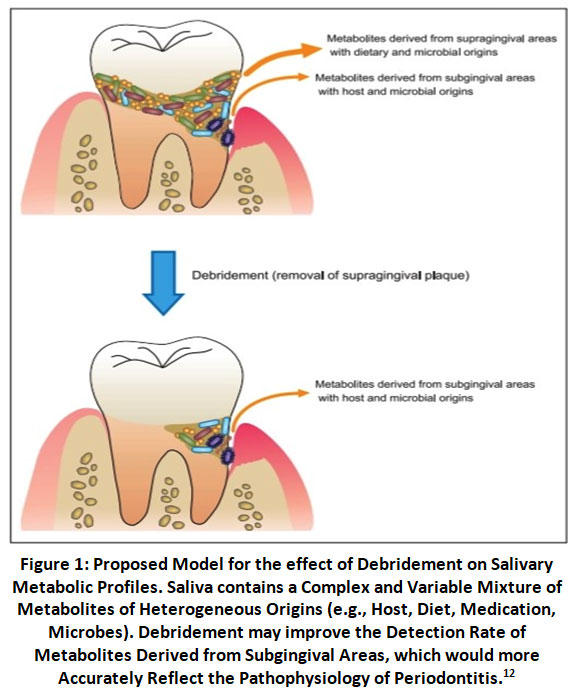 |
Figure 1: Proposed Model for the effect of Debridement on Salivary Metabolic Profiles. Click here to view Figure |
Human Studies in Metabolomics
Untargeted metabolomics can distinguish healthy individuals from periodontitis individuals.1 Metabolomics can also indicate the progression and stage of periodontal disease. Recently, nuclear magnetic resonance spectrometry is used for salivary phenotype characterization that is linked with chronic generalized periodontitis. In generalized aggressive periodontitis and chronic periodontitis, there is marked decrease in the level of N-acetyl groups, lactate and pyruvate and marked increase in the level of phenylalanine, proline and tyrosine. However, there is no specific profiling for generalized aggressive periodontitis. Alloinositol and urea increases whereas acetic acid, 2- deoxyguanosine and gluthathione decrease in generalized aggressive periodontitis. There is decrease in the level of 2 ketobutyric acid, thymidine, glycine-d5 and gluthathione and increase in xanthine, lysine, ribose, dehydroascorbic acid and noradrenaline is seen in GCF. These indicate purine degradation, oxidative stress, pyrimidine metabolism, tyrosine metabolism and biochemistry of bacteria in generalized aggressive periodontitis. After periodontal therapy, there is decrease in glutamine isoleucine, tryptophan, ethanolamine, fucose and alanine. Hydrocinnamate and cadaverine is associated with severe periodontal inflammation.8
In diabetes there is increased level of glucose in serum and decrease level of 1,5-anhydroglucitol. In non-diabetics, purine degradation is increased in case of periodontitis. Lactate, proline, isocaprocate, isovalerate and caprocate plays important role in periodontal disease progression.1 In deep periodontal pockets, there is increase of Ribose, galactose, 5-aminovaleric acid; lysine, phenylalanine and putrescine are increased in cases of deep periodontal pockets.
In deep periodontal pockets, there is increase in level of benzoic acid, lactic acid, malic acid and glycine. In periodontal disease, there is increase in the level of unidentified metabolites. Targeted lipidomics and spectrometry of mass based on ionomics of the fatty acid metabolites are helpful to find fatty acid differences in chronic periodontitis patients.1 Patient’s nutritional factors should be determined to know nutritional status of the patient with periodontitis. There is inverse relationship between periodontitis and antioxidant level. Vitamin A, C, E is decreased in periodontitis. Redox active metals are decreased in chronic periodontitis which can be seen in ionic profiling of saliva and plasma. In case of periodontitis, there is decrease in the level of manganese, copper and zinc. Also, there is decrease in the level of magnesium, calcium and potassium in case of metabolomics profiling in cases of periodontitis.8
In chronic periodontitis, there is decrease level of prostaglandin I2 and increase in the level of thromboxane B2, prostaglandin D2, Prostaglandin E2, prostaglandin F2 alpha while doing lipidomics. In chronic periodontitis, there is decrease in the levels of 9- hydroxyeicosatetraenoic acid and 13- hydroxyeicosatetraenoic acid while there is increase in the level of 5?hydroxyeicosatetraenoic acid. Also, there is elevation in the levels of lipid peroxidation free radicals and salivary F2, isoprostanes.8
Role of Microbes in Metabolomics
In periodontal disease, there is important role of bacterial metabolites in saliva. Salivary metabolites can be used for both supra and sub gingival plaque. Nowadays, efforts are made to know bacterial metabolism contribution in metabolomics profile of saliva in cases of periodontal problems. This metabolomics of saliva is used to know the presence and extend of periodontal disease in absence as well as presence of supra gingival plaque using post and pre debridement observation methods and spectrometry of mass using chromatography of gas. 5-oxoproline, ornithine, valine, spermidine, proline, hydrocinnamate, cadaverine and histidine are the metabolites associated with periodontitis. There is decrease in the level of spermidine, ornithine and 5?oxoproline after treatment of periodontitis.1
In summary, pathogenesis of microbial disease at microbial level can be understood with the help of proteomic, transcriptomic and metabolomic studies. Oral micro biome, tissue homeostasis, metabolic process of host, host immune response can be easily understood with the help of these studies. Also, with the help of these studies, we can easily diagnose and treat different stages of periodontitis more efficiently.1
Methods to Detect Metabolites
Mass-Spectrometry mostly coupled with chromatographic techniques are gaining attention in metabolomics.13 Other methods of detecting metabolites are gas chromatography, capillary electrophoresis, liquid chromatography, nuclear magnetic resonance.13 Gas chromatography of mass spectrophotometry can be used for metabolomics profiling of saliva.12 Also, we can use 16s ribosomal RNA gene high throughput sequencing for metabolomics profiles.14
Discussion
Biochemical profiling can be used to assess different global metabolism in the saliva in periodontal disease and healthy individuals. Various metabolic changes are associated with periodontal disease. The levels of the fatty acids, monosaccharides and dipeptides are increased that indicating increased lipase, glycosidase and protease activities in the periodontitis. The macromolecular degradation results in increased availability of the readily accessible metabolites that are needed for the energy production with the help of the oral microflora. Therefore, greater fertile environment is present for bacterial expansion in periodontitis. The understanding of how bacterial infections can affect the host in altering salivary metabolism in the apparent benefit of bacteria is very limited. It is quite interesting to find that P. gingivalis and lot of other bacteria are unable to utilize the saccharides as carbon and the energy sources and they instead rely on the oligopeptides for the biomass generation. The total absence of the elevated levels of the free amino acids is found to be consistent with dipeptides uptake for the use of energy by the bacteria.
Liebsch.C et al found in there study that periodontitis effects more middle aged individuals and there is more role of number of teeth in old age individuals.1 Romano F et al concluded in their study that there is change in the level of metabolites in saliva after initial periodontal therapy.5 They also suggested that better understanding of metabolites can help in better diagnosis of periodontitis.5 Bostanci N et al said that metabolomics and Metaproteomics are contemporary fields that complement the foundations of metatranscriptomics and metagenomics which helps in understanding the microbial communities of the oral ecosystem, also they help to better understand functions in different environmental situations and states of health. 15 Citterio et al found in their study that metabolic profiling can be used for evaluating stages of treatment and can distinguish between previous and active periodontitis.16 Shi M et al in their study found that more than 70 genera had a relation with at least with one clinical index of the periodontitis.14 Gowron K et al in their study found that bacteria associated with chronic periodontitis has greater metabolic activity which can be diagnosed by changes in lactate, isopropanol, acetone, methanol and glycerol when compared to normal flora of the oral cavity. 17 Trindade F et al said that NMR (nuclear magnetic resonance) is a method to detect metabolites in salivary oral fluids which are responsible for periodontitis.18 Pei Jun et al said that Omics is the recent technology to detect biomarkers of periodontal disease. He also said that next generation sequencing (NGS) is a advanced technology to detect microbes in periodontitis. Metabolomic profiling of GCF can be done wih the help of 16S RNA and gas chromatograph-mass spectrophotometry.19 Mikkonen J J W said that immunoassay can be used to detect matrix metalloproteinase 8 in periodontal diseases. He also told about lithographic microchip which is based on electrophoretic immunoassay system that is used for rapid measurement of matrix metalloproteinase-8 with help of enzyme linked immunosorbent assay.20 8-Hydroxy-deoxyguanosine is also a salivary marker of the periodontal disease but its utility in markers is uncertain.20 There is increase in the level of dipeptides, fatty acids and monosaccharides indicating rise in activity of protease lipase and glycosidase enzymes in periodontitis.20
Advantages of Metabolomics
Saliva metabolic profile can help in detecting early changes associated with various diseases like periodontitis and oral cancer.20 Salivary metabolic profiling can help in diagnosing various systemic and local diseases.20 It can also help in better treatment of various diseases.20
Limitations
Every study have some limitations, same is the case with metabolomics. We cannot determine the exact origin of a particular metabolite. Metabolites can be a derivative of host tissue breakdown, supragingival plaque, saliva or bacterial communities.1 There are some limitations. One of the major problems with oral metabolites is that there is no way to determine their true origin. They could be essential constituent of the patient unique saliva, they could derive from the breakdown of the host tissues as from the bacterial communities, even from the supragingival plaque.
Conclusion
Metabolites in periodontitis are mainly derived from bacterial metabolism. Metabolomics can help in the early, rapid diagnosis of periodontitis and stage of periodontitis. Also, it can help up in follow-up evaluation of periodontitis. In conclusion, metabolites are the recent and promising choice for diagnosis, treatment and follow-up of patients with periodontitis.
Acknowledgments
The author would like to thank faculty members of the Department of Periodontology and Implantology Teerthanker Mahaveer Dental College and Research Centre, Moradabad for their guidance and support to complete this article.
Funding Source
There is no funding and financial support for this review article.
References
- Liebsch.C, Pitchika.V, Pink.C, Samietz.S, Kastenmüller.G and Artati.A. (2019). The Saliva Metabolome in Association to Oral Health Status. J Dent Res.2019;1-10.
- Acker-Hewitt TL, Shafer BM, Saunders MJ, Goh Q, Luden ND. Independent and combined effects of carbohydrate and caffeine ingestion on aerobic cycling performance in the fed state. Appl Physiol Nutr Metab. 2012;37: 276– 283.
CrossRef - Garcia-German D, Viloria F, Menendez P, Canillas F. Surgery on the wrong side: implication for the patient and the professional. Experience in a major ambulatory surgery of the foot unit. Rev Esp Cir Ortop Traumatol.2012;56: 421-422.
CrossRef - Goodson JM, Hartman ML, Shi P.The salivary microbiome is altered in the presence of a high salivary glucose concentration. PLoS One.2017;12.
CrossRef - Romano F, Meoni G, Manavella V, Baima G, Mariani GM, Cacciatore S et al. Effect of non-surgical periodontal therapy on salivary metabolic ?ngerprint of generalized chronic periodontitis using nuclear magnetic resonance spectroscopy.Archives of Oral Biology.2018:2-25.
CrossRef - Listgarten M A. Pathogenesis of periodontitis. J Clin Periodontol.1986;13: 418-425.
CrossRef - Rai B, Kharb S, Jain R and Anand S C. Biomarkers of Periodontitis in oral fluids. Journal of oral science. 2008;50(1):53-56.
CrossRef - Oliver SG, Winson MK, Kell DB, Baganz F. Systematic functional analysis of the yeast genome. Trends Biotechnol.1998;16(9):373-378.
CrossRef - Shirasugi M, Nishioka K, Yamamoto T, Nakaya T, Kanamura N. Normal human gingival fibroblasts undergo cytostasis and apoptosis after long-term exposure to butyric acid. Biochemical and Biophysical Research Communications. 2016;482(2):1-7.
CrossRef - Chang MC, Chen YJ, Lian YC, Chang BE, Huang CCH, Huang WL, Pan YH et al. Butyrate Stimulates Histone H3 Acetylation, 8-Isoprostane Production, RANKL Expression, and Regulated Osteoprotegerin Expression/Secretion in MG-63 Osteoblastic Cells. Int. J. Mol. Sci. 2018;19:1-17.
CrossRef - Kumar PS. Diversity of Oral Biofilms in Periodontal Health and Disease. Pathogenesis of periodontal diseases. 2017:9-20.
CrossRef - Kuboniwa M, Sakanaka A, Hashino E, Bamba T, Fukusaki E and Amano A. Prediction of Periodontal Inflammation via Metabolic Profiling of Saliva. J Dent Res. 2016;95(12):1381-1386.
CrossRef - Gupta P, Gupta S, Pruthi V. Techniques for Detection and Extraction of Metabolites. Eng Micro Biosyn Pathways.2020;1:33-51.
CrossRef - Shi M, Wei Y, Nie Y, Wang C, Sun F, Jiang W et al. Alterations and Correlations in Microbial Community and Metabolome Characteristics in Generalized Aggressive Periodontitis. Front. Microbiol.2020;11:11-14.
CrossRef - Bostanci N, Grant M, Bao K, Silbereisen A, Hetrodt F, Manoil D et al. Metaproteome and metabolome of oral microbial communities. Periodontology 2000. 2020;85:46-81.
CrossRef - Citterio F, Romano F, Meoni G, Laderosa G, Grossi S, Sobrero A et al. Changes in the Salivary Metabolic Profile of Generalized Periodontitis Patients after Non-surgical Periodontal Therapy: A Metabolomic Analysis Using Nuclear Magnetic Resonance Spectroscopy. J. Clin. Med. 2020;9:1-12.
CrossRef - Gawron K, Wojtowicz W, Bartyzel KL, Lamasz A, Qasem B, Pydel M et al. Metabolomic Status of The Oral Cavity in Chronic Periodontitis. In Vivo. 2019;33(4):1165-1174.
CrossRef - Trindade F, Oppenheim F G, Helmerhorst E J, Gomes PS and Vitorino R. Uncovering the metabolomics network in periodontitis. Proteomics- Clinical Applications. 8(9-10);748-761.
CrossRef - Pei J, Li1 F, Xie Y, Liu J, Yu1T and Feng1 X. Microbial and metabolomic analysis of gingival crevicular fluid in general chronic periodontitis patients: lessons for a predictive, preventive, and personalized medical approach. EPMA Journal.2020;11: 197-215.
CrossRef - Mikkonen JJW, Singh SP, Herrala M, Lappalainen R, Myllymaa S, Kullaa AM. Salivary metabolomics in the diagnosis of oral cancer and periodontal diseases. J Periodont Res. 2015;51(4):431-437.
CrossRef